
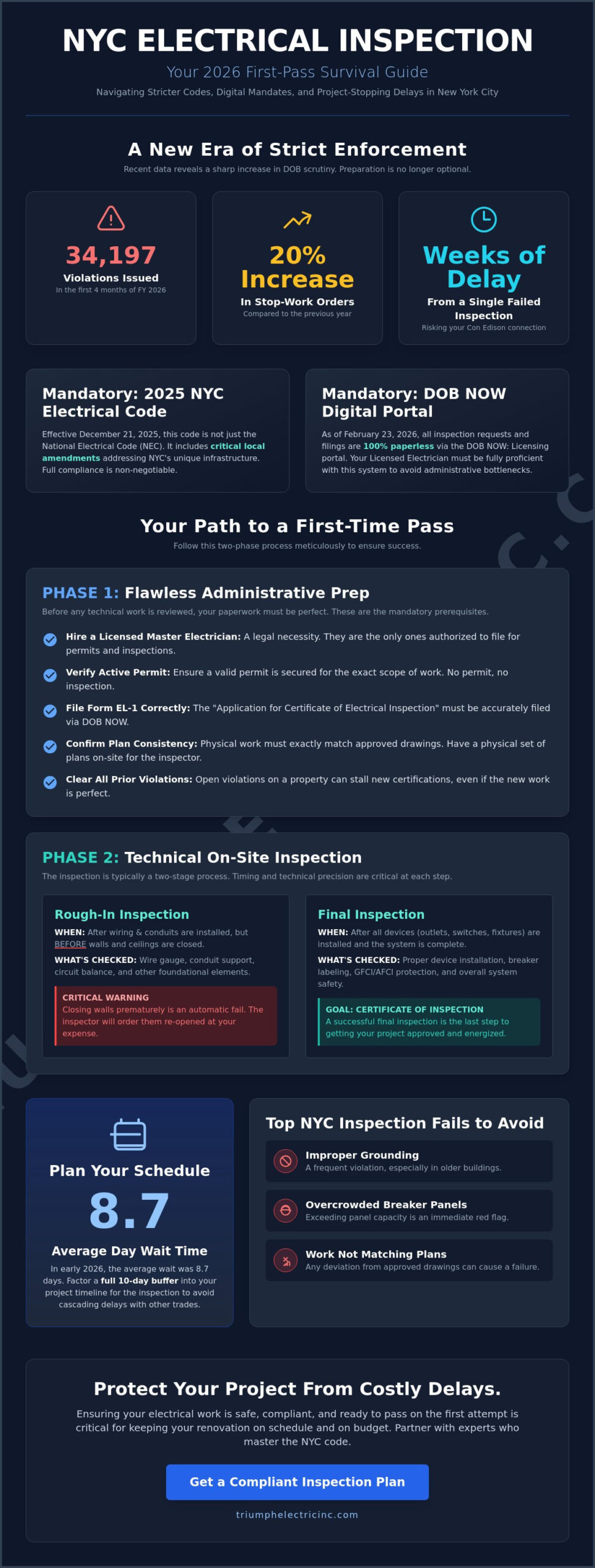
The NYC Department of Buildings issued 34,197 violations in the first four months of fiscal year 2026, which is a notable increase that highlights a new era of stricter code enforcement. With stop-work orders rising by 20 percent compared to last year, learning how to prepare for an electrical inspection nyc is the only way to protect your project from costly administrative bottlenecks. Whether you are managing a service upgrade or a complex fire alarm installation, the margin for error has never been thinner.
It’s natural to feel anxious about a looming DOB inspection, particularly when a single failed walkthrough can delay your Con Edison service connection for weeks. You want to ensure your building is safe and compliant without the stress of unexpected non-compliance notices. This 2026 guide provides a professional framework to help you master the NYC inspection process and pass on your first attempt. We will cover the mandatory 2025 New York City Electrical Code standards, the latest DOB NOW digital filing requirements, and the critical technical milestones you must hit to keep your renovation schedule on track.
Key Takeaways
- Learn the exact steps for how to prepare for an electrical inspection nyc by aligning your project with the mandatory 2025 NYC Electrical Code and the latest DOB NOW digital filing mandates.
- Ensure your administrative paperwork is flawless by verifying active permits and correctly processing the Application for Certificate of Electrical Inspection (Form EL-1) through the digital licensing portal.
- Identify the specific technical requirements for both rough-in and final inspections, focusing on critical factors like wire gauge, conduit support, and circuit balance.
- Avoid common NYC-specific violations, such as improper grounding in older buildings and overcrowded breaker panels, that frequently lead to failed inspections and project delays.
- Understand the legal necessity of partnering with a Licensed Master Electrician to manage the inspection process and represent your project’s compliance to Department of Buildings officials.
Understanding the NYC DOB Electrical Inspection Landscape
The regulatory environment for electrical work in the five boroughs is uniquely rigorous. Understanding how to prepare for an electrical inspection nyc begins with the 2025 New York City Electrical Code, which became mandatory on December 21, 2025. This code isn’t just a copy of the National Electrical Code; it includes specific local amendments that address the density and complexity of our city’s infrastructure. The New York City Department of Buildings (DOB) mandates inspections for all permitted work to ensure every circuit, panel, and fire alarm system adheres to these strict safety benchmarks.
Failing to meet these standards carries a high price. The DOB issued over 34,000 violations in the first four months of fiscal year 2026, often resulting in immediate Stop Work Orders. These orders halt project momentum and require mandatory re-filing fees, which now carry a minimum cost of $130. Efficiency is now tied to digital proficiency. As of February 23, 2026, the DOB NOW: Licensing portal is the exclusive platform for processing trade applications. Every step of the inspection request process is now paperless, requiring a licensed electrician NYC who is fully integrated with the DOB NOW system.
The Role of the Bureau of Electrical Control (BEC)
The Bureau of Electrical Control (BEC) functions as the technical authority within the DOB, overseeing electrical safety standards across Manhattan, Brooklyn, and the outer boroughs. While some smaller residential tasks might qualify for self-certification by a Master Electrician, most substantial projects require a mandatory field inspection. High-voltage installations and complex commercial systems face the highest level of BEC scrutiny. Securing a licensed electrical contracting firm is vital for navigating these requirements, as they represent your interests during these high-stakes walkthroughs.
The Timeline: When to Request Your Inspection
Timing is everything when coordinating a renovation. You must request a “Rough” inspection once the wiring and conduits are installed but before any walls or ceilings are closed. If you close the walls prematurely, the inspector will order them reopened at your expense. In early 2026, the average wait time for an inspection was 8.7 days. You should factor this ten-day window into your project schedule. Proper coordination with your plumbing and carpentry teams is essential to ensure the site is accessible and ready for the inspector’s arrival. This discipline prevents the scheduling conflicts that often lead to failed visits and additional fees.
Administrative Preparation: Paperwork and Permits
Administrative precision is just as critical as technical skill. When you’re determining how to prepare for an electrical inspection nyc, the first step is verifying that your licensed electrician NYC has secured an active, valid permit for the specific scope of work. Without this permit, the inspector won’t even step onto the property. You must also ensure that the ‘Application for Certificate of Electrical Inspection’, commonly known as Form EL-1, is correctly filed and reflects the actual installation. This form acts as the official request for the DOB to review your project’s compliance.
Discrepancies between the physical work and the approved architectural or electrical drawings are a frequent cause of failure. The NYC Electrical Code builds upon the safety standards of the National Electrical Code (NEC), but it adds unique local requirements that your drawings must reflect. Before the inspector arrives, confirm that any previous NYC electrical violation removal tasks have been officially closed. Open violations on a property can stall new certifications, even if the current work is perfect. Having a physical set of the approved plans on-site is a requirement that many owners overlook, yet it’s essential for the inspector to verify the circuit paths and load calculations.
The DOB NOW: Build Portal Requirements
The transition to the DOB NOW: Build portal means property owners are now active participants in the filing process. You must ‘sign off’ on digital applications before they can proceed. It’s a good practice to verify your permit status online via the portal to confirm there are no pending objections. Common filing errors, such as incorrect community district labeling or mismatched PIN numbers, often lead to automatic rejections before a site visit even occurs. Ensuring your digital profile is updated and linked to your Master Electrician’s filing is the only way to avoid these clerical delays.
Con Edison Coordination for Service Upgrades
For projects involving a Con Edison service upgrade, administrative coordination becomes even more complex. You must have a valid ‘Work Request’ number, which serves as the primary identifier for your project with the utility. The DOB inspection must be successfully completed and signed off before Con Edison will schedule a crew to set the meter or energize the new service. If you’re struggling with paperwork, our team can help you manage electrical violation removal and filing to ensure your power is restored without delay.
Rough-In vs. Final Inspections: Prep Checklists
Successful regulatory outcomes depend on understanding that the NYC Department of Buildings views a project in two distinct stages. Mastering how to prepare for an electrical inspection nyc requires a different set of priorities for the rough-in versus the final walkthrough. You cannot simply finish the job and call for a single visit. The ‘Visible and Accessible’ rule is the governing principle here. An inspector must be able to physically see the conduit runs, box connections, and grounding bonds before they are concealed by drywall or plaster. Skipping the rough-in phase, even for minor NYC apartment renovations, is a violation that leads to mandatory wall removal and project restarts.
Phase 1: The Rough-In Inspection Prep
The rough-in inspection occurs while the building’s skeleton is exposed. This is the stage where the inspector verifies the foundational safety of the installation. Your checklist must prioritize the following technical details:
- Wire Gauge and Type: Inspectors will verify that the conductor size matches the breaker rating and that the wire insulation type is approved for the environment.
- Nail Plate Installation: All wiring passing through studs must be protected by steel nail plates to prevent future puncture from drywall screws.
- Conduit Support: Every run of EMT or MC cable must be secured at the intervals specified by the 2025 NYC Electrical Code.
- Box Fill and Grounding: Inspectors check box fill calculations to ensure enclosures aren’t overcrowded. All metal boxes must be properly bonded to the grounding system.
- Debris Removal: You must remove all construction dust, wire clippings, and plaster from electrical boxes. A dirty box suggests poor workmanship and invites closer scrutiny.
Phase 2: The Final Inspection Prep
The final inspection happens once the project is complete and the system is ready to be energized. At this stage, the focus shifts from the infrastructure to the devices and user safety. The inspector will verify that every outlet, switch, and fixture is fully installed and functional. Cover plates must be on, and no live wires should be exposed.
One of the most common reasons for failure during this phase is a sloppy panel directory. Your circuit breaker panel directory must be typed and 100% accurate. Handwritten labels are no longer acceptable under current DOB standards. Additionally, you must perform a pre-inspection test on all GFCI and AFCI devices. The inspector will use a circuit tester to ensure every safety breaker trips as intended. If a single GFCI in a kitchen fails to trip, the entire inspection fails. Balancing the load across the bus bar is also critical. Inspectors may check for circuit balance to prevent overheating in the main panel, ensuring the building’s long-term electrical stability.
Common NYC Electrical Code Violations to Avoid
Avoiding the 34,197 violations issued by the Department of Buildings in early 2026 requires a disciplined approach to technical details. When considering how to prepare for an electrical inspection nyc, identifying common pitfalls before the inspector arrives is your most effective defense. Many of these failures aren’t the result of major system flaws but rather small, overlooked errors that signal a lack of professional oversight. Every component used must be UL-listed and specifically approved for use within New York City’s unique regulatory environment.
Improper grounding remains the primary reason for inspection failure, especially in older Brooklyn brownstones and pre-war buildings where legacy systems often clash with modern requirements. Inspectors will verify the integrity of the grounding electrode conductor and the bonding of all metallic piping systems. Another frequent issue is the overcrowding of circuit breaker panels. Exceeding the manufacturer’s circuit limit for the bus bar or using “cheater” breakers to add more circuits than a panel is rated for will result in an immediate failure. Maintaining adequate clearance is also mandatory. You must provide a clear workspace in front of all electrical equipment that is at least 30 inches wide and 36 inches deep to allow for safe maintenance and emergency access.
Wiring and Support Violations
Precision in wiring support is a hallmark of a professional installation. Cables such as BX or Romex must be secured within 12 inches of every electrical box and at regular intervals along the run. Failure to provide this support suggests a lack of discipline that inspectors will penalize. We also see frequent errors regarding wire sizing. For example, using #14 AWG wire on a 20A circuit is a significant safety violation. Additionally, you must never mix low-voltage data lines and high-voltage power wires in the same raceway or junction box, as this creates interference and safety risks.
Labeling and Documentation Failures
Administrative errors can stall a project just as easily as technical ones. Commercial installations require prominent ‘High Voltage’ warning signs on all relevant equipment and switchgear. You must also have ‘As-Built’ drawings physically present on-site during the walkthrough so the inspector can verify the installation against the approved plans. Incomplete circuit identification in the main distribution frame is another common hurdle. Every breaker must be clearly and accurately labeled. If you are currently facing a DOB notice for any of these issues, our experts specialize in Electrical Violation Removal to bring your property back into compliance quickly.
The Triumph Advantage: Why a Master Electrician is Mandatory
In the five boroughs, the legal barrier to entry for electrical work is absolute. Only an NYC Licensed Master Electrician possesses the authority to pull permits and represent a project before the Bureau of Electrical Control. When you’re finalizing how to prepare for an electrical inspection nyc, you aren’t just looking for a technician; you’re securing a legal representative for your building’s infrastructure. Partnering with a licensed electrical contracting firm ensures that every circuit breaker panel installation or service upgrade is backed by professional liability insurance and a deep understanding of local amendments.
Professional representation on-site is the difference between a same-day approval and a weeks-long delay. Inspectors speak a specific technical language. They look for disciplined workmanship and adherence to the 2025 NYC Electrical Code. When a Master Electrician is present during the walkthrough, they can provide immediate context for complex installations, such as fire alarm system wiring or data and voice cabling. This advocacy protects your property value and ensures that the work is certified as safe and code-compliant, which is a critical requirement for future property sales or insurance audits.
Our Inspection Walkthrough Process
Triumph’s approach to how to prepare for an electrical inspection nyc begins long before the inspector arrives. We conduct a rigorous pre-inspection audit to identify and resolve potential issues that the DOB might flag. During the actual walkthrough, our team acts as your advocate, explaining the technical rationale behind the design to the inspector. If an inspector identifies a minor ‘punch-list’ item, we often resolve it on the spot. This proactive discipline is why we consistently achieve successful outcomes on the first attempt, helping you avoid the 20 percent increase in stop-work orders seen across the city this year.
Closing the Loop: Post-Inspection Success
Passing the inspection is a major milestone, but the process doesn’t end there. We handle the administrative follow-up to secure your ‘Letter of Completion’ or ‘Certificate of Electrical Inspection.’ These documents are the only way to finalize a Con Ed meter set and legally energize your building. Once the inspection is signed off in the DOB NOW portal, we archive your compliance documents for your records. This methodical approach ensures your renovation stays on schedule and your building remains a safe, compliant asset for years to come.
Secure Your Project’s Regulatory Approval
Navigating the complexities of the 2025 NYC Electrical Code requires more than just technical skill. It demands a methodical approach to administrative compliance. You now understand that mastering how to prepare for an electrical inspection nyc involves balancing digital filing precision in the DOB NOW portal with rigorous on-site checklists for both rough-in and final walkthroughs. By identifying common pitfalls like improper grounding and overcrowded panels early, you protect your renovation from the rising tide of stop-work orders and mandatory re-filing fees.
Triumph Electrical provides the authoritative expertise you need to clear these hurdles on the first attempt. As a Licensed NYC Master Electrician (#12345), we specialize in NYC DOB Violation Removal and provide support across all five boroughs. We ensure your electrical system is a safe, code-compliant asset that adds lasting value to your property. Schedule a Pre-Inspection Audit with Triumph Electrical Today to secure your project’s timeline and eliminate the anxiety of non-compliance. Your path to a successful, stress-free inspection starts with a disciplined professional partner.
Frequently Asked Questions
Do I need to be home for the NYC electrical inspection?
You don’t necessarily need to be present, but the property must be accessible and a representative of the Licensed Master Electrician must be on-site. The inspector needs to move through the building without delay to verify specific code points. Having a professional who understands how to prepare for an electrical inspection nyc present ensures that technical questions are answered immediately, which often prevents a failure due to simple misunderstandings.
How long does a typical NYC DOB electrical inspection take?
A typical inspection usually lasts between 15 and 45 minutes, depending on the scale of the project. For a simple circuit breaker panel installation, the process is relatively quick. Larger commercial projects or complex fire alarm system wiring can take longer as the inspector verifies multiple termination points. The key is having all covers removed and documentation ready to ensure the inspector’s time is used efficiently.
What happens if my electrical inspection fails?
If the inspection fails, the inspector will issue a notice of objection detailing the specific code violations. You must correct these issues before requesting a re-inspection through the DOB NOW portal. Failed inspections often result in project delays and additional filing fees. It’s best to have your electrician perform a thorough audit before the official visit to avoid these administrative bottlenecks and keep your renovation on schedule.
Can I perform my own electrical work and have it inspected in NYC?
No, New York City law strictly prohibits property owners from performing their own electrical work. All electrical installations must be completed and filed by a Licensed Master Electrician. This regulation ensures that high-stakes safety standards are met across the five boroughs. Attempting “DIY” electrical work will lead to significant fines, the denial of permits, and potential safety hazards that could void your property insurance.
How do I check if my electrician has actually filed for a permit?
You can verify permit status by using the DOB NOW: Build public portal. Simply enter your property address to see all active and pending electrical filings. A legitimate permit will list the name of the Licensed Master Electrician and the specific scope of work. Checking this early is an essential step in how to prepare for an electrical inspection nyc, as it confirms the administrative foundation of your project is secure.
Is there a difference between a DOB inspection and a Con Edison inspection?
Yes, these are two distinct processes with different objectives. The DOB inspection focuses on whether the installation complies with the 2025 NYC Electrical Code and is safe for occupancy. A Con Edison inspection is specifically for the service connection and meter setting. While the DOB must sign off first, Con Ed will conduct its own review to ensure the building’s equipment meets utility-specific standards before energizing the service.
How much does a re-inspection fee cost in NYC for 2026?
As of February 2026, the DOB has updated its fee structure. Most permit-related filings now carry a minimum fee of $130, which is an increase from previous years. The exact cost for a re-inspection can vary based on the construction cost and the specific filing type. You should verify the current balance in your DOB NOW account, as unpaid fees will prevent the scheduling of any subsequent site visits.
What should I do if I have an existing electrical violation on my property?
You should immediately contact a specialist in electrical violation removal to resolve the issue. Existing violations can prevent you from obtaining new permits or selling your property. A Licensed Master Electrician will inspect the non-compliant work, perform the necessary troubleshooting and repair, and file the required paperwork to dismiss the violation. Resolving these legacy issues is a mandatory prerequisite for any new electrical certification.