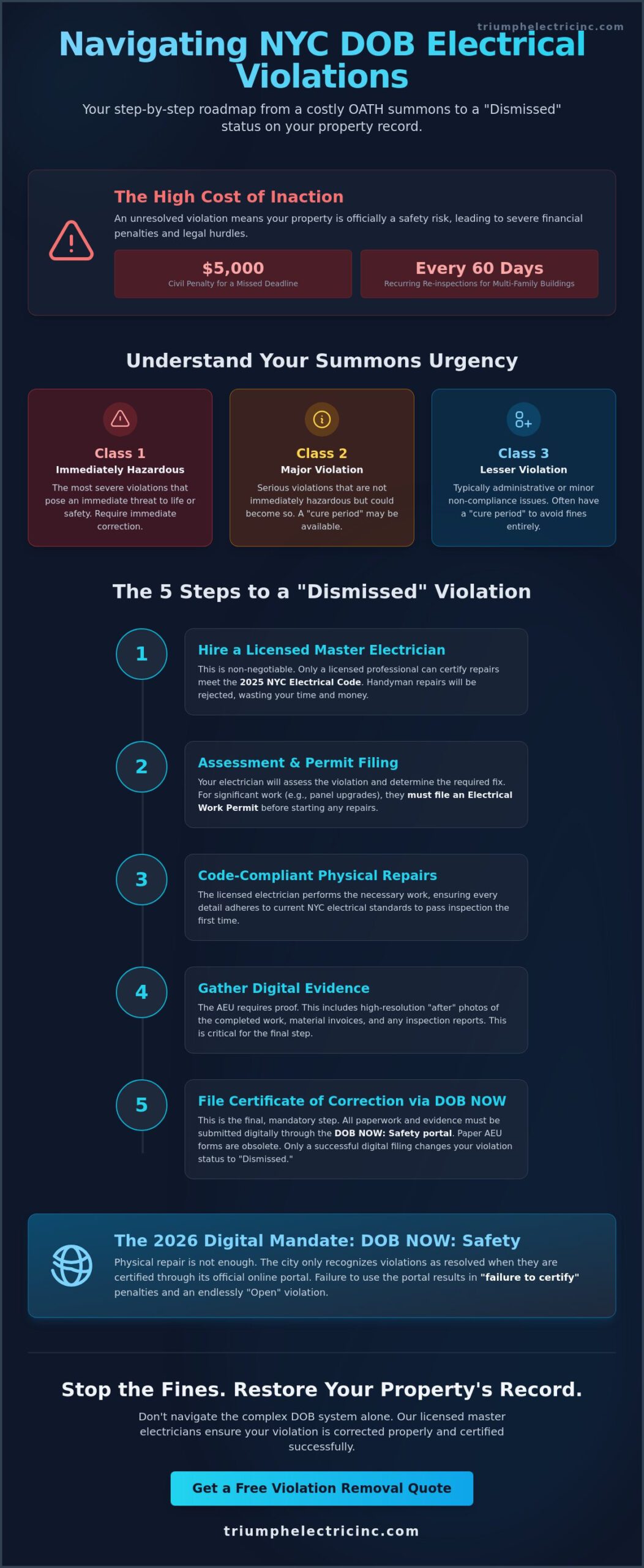
A DOB electrical violation correction certificate is more than just a piece of paperwork; it’s the only legal proof that your property is safe and code-compliant. If you’re staring at an OATH summons or a “Work Without a Permit” notice, you likely feel the pressure of escalating fines and the complexity of the mandatory DOB NOW: Safety portal. It’s stressful to manage a system where a single missed deadline can trigger a $5,000 civil penalty or recurring re-inspections every 60 days. You want the violation gone, the fines stopped, and your building’s reputation restored.
This guide provides a clear, step-by-step roadmap to help you resolve these summonses, file the correct digital paperwork, and finally secure a “Dismissed” status on your property profile. We’ll walk through the 2026 filing requirements, the importance of hiring a Licensed Master Electrician, and how to navigate the 2025 NYC Electrical Code to ensure you pass inspection the first time. By following this professional path, you’ll avoid additional AEUHAZ penalties and protect your investment with legitimate, certified repairs that meet the highest safety standards.
Key Takeaways
- Learn why the 2026 transition to the DOB NOW: Safety portal means paper AEU forms are no longer accepted for any violation filings.
- Discover why physical repairs aren’t enough and how to secure a DOB electrical violation correction certificate to officially dismiss summonses from your property record.
- Understand the critical differences between Class 1, 2, and 3 violations and how to use “cure periods” to potentially reduce your OATH fines to zero.
- Identify the specific steps for hiring a Licensed Master Electrician to ensure your repairs meet the 2025 NYC Electrical Code and pass inspection the first time.
- Get a clear roadmap for linking your eFiling account to your property profile to manage filings and avoid costly “failure to certify” penalties.
What is a DOB Electrical Violation Correction Certificate?
A DOB electrical violation correction certificate is the official legal document that proves a property owner has resolved an outstanding summons issued by the New York City Department of Buildings (DOB). This is not a paper form you keep in a drawer. It is a digital affirmation, filed exclusively through the DOB NOW: Safety portal, that confirms a hazardous or non-compliant electrical condition has been brought up to current standards. Without this specific filing, the city continues to view your property as a safety risk, regardless of whether the physical work is complete.
The Administrative Enforcement Unit (AEU) is the division responsible for reviewing these submissions. When you file a certificate, an AEU auditor examines your evidence, including photographs and proof of payment for any initial OATH fines. If they find the documentation lacking, they will reject the filing. This leaves the violation “Open” on your property profile, which can lead to escalating per-day penalties and “AEUHAZ” (Immediately Hazardous) additional fines of $5,000. For buildings with more than four families, the DOB will even perform re-inspections every 60 days until the certificate is accepted.
The Difference Between Fixing the Issue and Correcting the Violation
There is a massive gap between physical repair and legal dismissal. You might hire someone to replace a double-tapped breaker or ground a junction box, but the DOB doesn’t automatically know the work occurred. In the eyes of the city, a “fixed” condition is still a violation until the paperwork is approved. This “Open” violation trap is a major hurdle during property sales or refinancing in 2026. Title companies and lenders will flag these unresolved issues, often halting a closing until a DOB electrical violation correction certificate is secured and the status on the portal changes to “Dismissed.”
Who Can File for a Certificate of Correction?
While the property owner is legally responsible for ensuring the violation is corrected, they cannot simply sign off on the technical repairs themselves. New York City law requires a licensed electrician NYC to perform the work and certify that it meets the 2025 NYC Electrical Code. Handyman repairs are a recipe for rejection. A valid certificate requires a professional’s seal or a notarized statement from a Master Electrician who assumes responsibility for the safety of the installation. This ensures that the city’s infrastructure remains secure and that the repairs aren’t just a temporary patch, but a code-compliant solution.
How to Get Your Certificate of Correction: A Step-by-Step Guide
Clearing an electrical violation isn’t a solo mission. It’s a precise relay race between the property owner and a Master Electrician. The goal is to reach the finish line with a DOB electrical violation correction certificate that the city actually accepts. This process requires technical precision and administrative accuracy to avoid the trap of recurring fines. If you miss a single step in this sequence, the Department of Buildings will keep the violation “Open” on your property record.
The first step is identifying the specific NYC Electrical Code sections cited in your summons. You don’t need to be an expert, but you do need to hire a licensed electrician NYC who is. They’ll perform a professional assessment to ensure the repair goes beyond a simple patch job. If the correction requires significant changes, such as a panel upgrade or new wiring, your electrician must file an Electrical Work Permit before starting. Without that permit, the subsequent Certificate of Correction will likely be rejected by the Administrative Enforcement Unit (AEU).
Once the physical work is complete, you must gather evidence. This includes high-resolution “after” photos and all material invoices. Finally, you or your authorized representative must submit Certificate of Correction requests online through the DOB NOW: Safety portal. This is the only way to officially input correction data and upload your proof in 2026.
Professional Assessment and Repair
Matching the repair to the 2025 NYC Electrical Code amendments is critical. A seasoned professional ensures that the fix isn’t just functional but fully compliant with the latest safety standards. We document every stage of the repair process. This detailed documentation provides the AEU auditor with the confidence they need to approve your filing. If you’re dealing with a complex summons, our experts can handle your electrical violation removal to ensure the job is done right.
Preparing the Submission Package
Your submission package is your legal defense. “Proof” consists of clear photos, receipts, and the electrician’s certification. The most important element is the “Statement of Correction.” This document must describe exactly what was done using technical terminology. Rejections are common when property owners provide blurry photos or vague descriptions like “fixed the wires.” Precision in this package is what allows you to pass inspection the first time and stop the clock on city penalties.
Class 1, 2, and 3: Understanding Your Summons Urgency
The Department of Buildings categorizes every summons into one of three classes based on the severity of the hazard. This classification determines your deadline for repair and the potential cost of your fines. You’ll find this designation clearly marked on your OATH summons. Ignoring these distinctions is a costly mistake. If you don’t file your DOB electrical violation correction certificate within the specific window assigned to your class, the city’s automated system will trigger additional penalties that often exceed the original fine.
Class 1 violations are labeled “Immediately Hazardous.” These require correction within 24 hours. Because there is no “cure period” for Class 1 issues, you’ll still have to pay a penalty even if you fix the problem instantly. Class 2 (Major) and Class 3 (Lesser) violations offer a small window of opportunity. If you correct these and submit your paperwork by the “Cure Date” listed on the summons, you can often have the hearing fine reduced to zero. However, even a minor Class 3 violation will remain a permanent “Open” mark on your property record, preventing you from obtaining or renewing a Certificate of Occupancy.
If you believe a violation was issued in error, you can challenge it at an OATH hearing. This requires documented proof, such as photographs or a letter from a Master Electrician, showing the condition didn’t exist or was already code-compliant at the time of inspection. Most owners find it more efficient to simply correct the issue and move toward dismissal.
Dealing with AEUHAZ (Immediately Hazardous) Violations
Failing to certify a Class 1 violation is a high-stakes gamble. For construction sites and buildings with more than four families, the DOB imposes a mandatory $5,000 civil penalty for “Failure to Certify.” This is separate from the base fine. If the repair involves a complex overhaul that takes longer than 24 hours, you must show active progress and request an extension through the AEU. We specialize in NYC electrical violation removal for these high-priority cases. We ensure the hazard is neutralized and the AEUHAZ status is cleared before the 60-day re-inspection cycle begins.
The OATH/ECB Hearing vs. The Certificate of Correction
Filing a certificate and attending your hearing are two different legal requirements. The hearing at the Office of Administrative Trials and Hearings (OATH) determines if you’re guilty and sets the fine. The Certificate of Correction tells the DOB the building is safe. Proving correction before your hearing date can lead to a 50% reduction in the penalty. Don’t assume the hearing officer will “talk” to the DOB portal. You must handle both sides of the process to reach a “Dismissed” status. We provide the technical evidence you need to prove your case and minimize your financial exposure.
Filing Through DOB NOW: Safety in 2026
The transition to a digital-only system is complete. As of late 2025, the New York City Department of Buildings officially phased out paper AEU2, AEU20, and AEU3321 forms. If you attempt to mail a physical document to the Administrative Enforcement Unit today, it will be ignored. Every DOB electrical violation correction certificate must now be processed through the DOB NOW: Safety portal. This move aims to streamline tracking, but it requires property owners to be more tech-savvy than in previous years. You can’t just “fix and forget” anymore; you must manage the digital record of your building’s safety.
To begin, you must create an eFiling account. This account acts as your digital identity within the DOB system. Once registered, you need to link this account to your specific property profile using the borough, block, and lot (BBL) numbers. This connection allows you to view active summonses and upload the necessary “Proof of Correction.” When preparing your digital files, ensure all photographs and invoices are in PDF or JPEG format. The portal has strict file size limits, so keep your documentation concise but high-resolution. After submission, you can track your progress in real-time. Your status will move from “Pending AEU Review” to “Approved” once an auditor verifies your repairs meet the 2025 NYC Electrical Code.
What to Do if Your Certificate is Disapproved
Rejections are common and often stem from minor technicalities. If your filing is disapproved, the AEU auditor will provide a specific rejection code and a brief comment in the portal. Common issues include blurry photos that don’t clearly show the repair or a “Statement of Correction” that lacks technical detail. You don’t always have to pay a second filing fee if you resubmit within the window provided in the auditor’s comments. However, repeated rejections can trigger additional audits or even re-inspections. If you find the portal requirements confusing, it’s time to partner with a licensed electrical contracting firm. Professionals know the specific language auditors look for and can ensure your resubmission is successful on the first try.
Filing Fees and Payment Methods
Navigating the financial side of compliance requires keeping your receipts organized. In 2026, the standard filing fee for a Certificate of Correction is $35. You must pay this fee online using a credit card or e-check before the AEU will begin their review. It’s vital to distinguish between this filing fee and your OATH/ECB penalty payments. Paying the fine does not cover the filing fee, and paying the filing fee does not dismiss the fine. Keep these transactions separate in your records to provide proof of payment if the city’s ledger doesn’t update immediately. If you need help managing these filings and ensuring your building stays compliant, contact Triumph Electrical to handle the technical and administrative heavy lifting.
Why Triumph Electrical is New York’s Brightest Choice for Violation Removal
Resolving a building summons requires more than just a quick fix; it demands a partner who understands the legal weight of a DOB electrical violation correction certificate. At Triumph Electrical Contracting Inc., we provide direct access to a NYC Master Electrician who manages your case from the initial site visit to the final portal approval. We don’t just fix wires; we clear records. Our deep expertise allows us to navigate the complexities of the Administrative Enforcement Unit (AEU) with precision, ensuring that your property is safe and your legal standing is restored.
Our team brings decades of experience to all five boroughs. Whether you manage a high-rise in Manhattan or own a historic brownstone in Brooklyn, we understand the specific infrastructure challenges of your neighborhood. We also recognize that safety hazards don’t follow a 9-to-5 schedule. That’s why we offer 24/7 emergency response for Class 1 “Immediately Hazardous” violations. When the city identifies a condition that puts lives at risk, we arrive fast to neutralize the hazard and start the certification process before the next 60-day re-inspection cycle begins.
The Triumph Advantage: Straight Shooter Service
We operate as “Straight Shooters” who value transparency above all else. You’ll never deal with hidden costs or surprise administrative fees. We provide upfront pricing for both the physical repair and the subsequent filing assistance. Our team maintains a deep knowledge of NEC standards and the specific 2025 NYC amendments, which is why we can confidently offer our “pass inspection the first time” promise. We take the burden of the DOB NOW: Safety portal off your shoulders. We handle the digital uploads, the technical descriptions, and the follow-up with auditors so you can focus on managing your property.
Contact Us to Clear Your Property Today
Getting started is simple. You can send us a clear photo of your OATH summons or DOB violation notice, and we’ll provide a rapid, professional quote. Our service area covers the entire city, including Manhattan, Brooklyn, Queens, The Bronx, and Staten Island. We’ve built our reputation on being a dependable guardian of New York’s infrastructure, from Long Island City to St. George. Don’t let an open violation jeopardize your property sale or lead to $5,000 “failure to certify” penalties. Take the first step toward a “Dismissed” status and schedule your violation inspection now with New York’s Brightest.
Secure Your Property’s Future with a Dismissed Status
Resolving an electrical summons is a technical and administrative challenge that requires absolute precision. You’ve learned that a physical repair is only half the battle; the legal dismissal of your case depends entirely on an approved DOB electrical violation correction certificate. By navigating the DOB NOW: Safety portal correctly and addressing the specific requirements of your violation class, you protect your property from escalating fines and permanent “open” marks on your title record. Don’t let the complexity of the 2025 NYC Electrical Code or the fear of AEU rejections slow you down. Partnering with a professional ensures your paperwork is handled legally and professionally the first time. We provide the expertise needed to bridge the gap between hazardous conditions and official compliance.
Get Your NYC Electrical Violation Cleared by Triumph Electrical. As a Licensed NYC Master Electrician, we provide 24/7 emergency violation repair and are specialists in passing DOB inspections the first time. Your building’s safety is your most valuable asset. Take action today to clear your record and restore your peace of mind.
Frequently Asked Questions
How long does it take for the DOB to approve a Certificate of Correction?
Approval typically takes between 30 and 90 days from the date of submission. This timeline includes the window for physical repairs, uploading documentation to the portal, and the administrative review by the AEU. The exact speed depends on the current volume of filings and the complexity of the hazard cited in your original summons.
Can I file a Certificate of Correction myself, or do I need an electrician?
You can technically submit the filing, but a Licensed Master Electrician must perform and certify the actual repairs. The DOB electrical violation correction certificate requires a professional’s seal or a notarized statement to prove the work meets the 2025 NYC Electrical Code. Most owners prefer their electrician to handle the filing to ensure the technical descriptions meet auditor standards.
What happens if I miss the “Cure Date” on my NYC electrical violation?
Missing the “Cure Date” means you lose the opportunity to have your fine reduced to $0. The penalties from your OATH summons will become final and must be paid in full. You’re still legally required to fix the hazard and file your certificate, but you’ll no longer benefit from the city’s financial leniency window.
Is there a fee to file a Certificate of Correction in 2026?
The standard fee for submitting a Certificate of Correction through the DOB NOW portal is $35 in 2026. This is a processing fee for the Administrative Enforcement Unit and is separate from any fines you might owe to OATH. You must pay this fee online via credit card or e-check before the review process begins.
How do I know if my electrical violation has been officially dismissed?
Your violation is officially dismissed when the status on the DOB NOW: Safety portal changes to “Dismissed.” You’ll also receive a digital notification once the AEU approves your DOB electrical violation correction certificate. It’s important to verify this status online rather than assuming a paid fine automatically closes the case.
Can I sell my NYC house with an open electrical violation?
Selling a property with an open violation is possible but difficult because title companies and lenders will flag the issue. Most banks won’t issue a mortgage for a property with an active “Immediately Hazardous” condition. Sellers often have to escrow a large sum or resolve the violation entirely to satisfy the buyer’s title insurance requirements.
What is the penalty for a “Failure to File” a Certificate of Correction?
The penalty for failing to certify a Class 1 violation is a mandatory $5,000 civil penalty. For other classes, failing to file can lead to default penalties that reach as high as $25,000. These administrative fines are recurring and can quickly exceed the cost of the actual electrical repair work.
Do I need to attend my OATH hearing if I already filed the certificate?
You must still attend your hearing or admit guilt and pay the fine through the OATH portal. Filing the certificate only proves the building is safe; it doesn’t resolve the legal summons for the initial violation. However, proving you fixed the issue before the hearing date can lead to a 50% reduction in your penalty.