
With over 320,000 active building violations currently clogging the NYC Department of Buildings records, your property’s electrical system is under more scrutiny than ever. Managing a building in the five boroughs means facing a reality where a simple oversight leads to massive fines. Understanding the current GFCI outlet installation requirements nyc isn’t just a safety recommendation; it’s a legal necessity to avoid civil penalties that can reach 21 times the permit fee for commercial properties. Under the 2025 New York City Electrical Code, which took full effect on December 21, 2025, the standards for protection are higher and the enforcement is stricter.
You likely find the constant updates to local amendments and the overlap between national and city codes frustrating. It’s stressful to worry about whether your older building meets the latest safety benchmarks or if a surprise inspection will result in a Class 1 violation. This guide will help you master these strict requirements to ensure your property remains safe, legal, and free from Department of Buildings interference. We’ll cover mandatory installation locations for 2026, the specifics of the 2025 code amendments, and the steps for successful electrical violation removal to keep your operations running smoothly.
Key Takeaways
- Understand the hierarchy between the National Electrical Code and NYC-specific amendments to ensure your building’s wiring follows the correct legal standard.
- Identify every mandatory location in residential kitchens and bathrooms to meet the strict GFCI outlet installation requirements nyc and protect your tenants.
- Learn the specific 2026 mandates for commercial spaces and rooftop service outlets to prevent workplace accidents and costly stop-work orders.
- Recognize common installation errors like reverse polarity and improper grounding that lead to failed inspections and Class 1 DOB violations.
- Discover the professional steps required for successful electrical violation removal to clear your property’s title and stop ongoing financial penalties.
Understanding the 2026 NYC Electrical Code for GFCI Protection
A Ground Fault Circuit Interrupter is a specialized safety device designed to prevent electrocution by constantly monitoring the electricity flowing through a circuit. To understand what a GFCI is in a technical sense, you should view it as a high-speed sensor that detects imbalances as small as 5 milliamperes. If current leaks from the circuit, the device trips in a fraction of a second. This rapid response is why the New York City Department of Buildings (DOB) makes these outlets a cornerstone of every safety inspection. In a city with aging infrastructure and high-density living, the shock protection provided by these devices isn’t optional. It’s a fundamental requirement for legal occupancy.
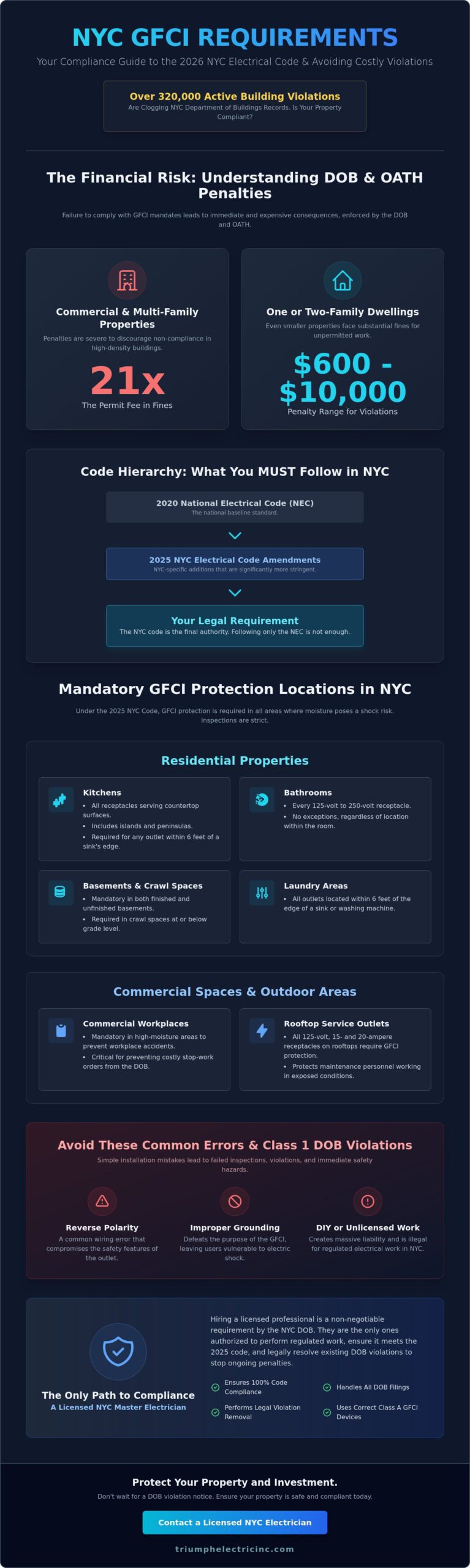
Navigating the GFCI outlet installation requirements nyc involves more than just reading a manual. The city operates under a dual-track enforcement system. The DOB issues the violation, while the Office of Administrative Trials and Hearings (OATH) manages the financial penalties. If your building fails to meet these standards, the consequences are immediate and expensive. For one- or two-family dwellings, penalties for unpermitted or non-compliant work start at $600 and can reach $10,000. For commercial and multi-family properties, the fine is calculated at 21 times the permit fee. With over 320,000 active DOB violations currently on record, the city isn’t overlooking these safety gaps.
NEC vs. NYC DOB Amendments: What is the Difference?
The 2025 New York City Electrical Code took full effect on December 21, 2025. While this code is based on the 2020 National Electrical Code (NEC), it includes several NYC-specific amendments that are significantly more stringent. You can’t simply follow the national standard and assume you’re safe from local fines. NYC often adds “bulletproofing” to national rules to account for the unique density of the five boroughs. The NYC DOB mandates GFCI protection in all high-moisture areas to mitigate the heightened risk of electrical shock in close-quarters urban dwellings and commercial facilities.
The Role of a Licensed NYC Master Electrician
Installing these devices yourself or hiring an unlicensed handyman creates a massive liability. The city requires a licensed electrician nyc to perform and sign off on all regulated electrical work to ensure it meets the 2025 code. Licensed professionals ensure that the correct Class A GFCI is used for personnel protection. They also handle the necessary filings to ensure your property remains in good standing. If you already have a notice on your door, a Master Electrician is the only person who can facilitate legitimate electrical violation removal to clear your record and stop the accumulation of daily fines.
Mandatory GFCI Locations in NYC Residential Properties
Residential compliance in New York City hinges on specific room designations and proximity to water sources. The NYC Department of Buildings (DOB) enforces these rules to prevent life-threatening shocks in high-moisture environments. Meeting the GFCI outlet installation requirements nyc requires a precise inventory of your home’s electrical layout. Under the 2025 code, the city has expanded the list of required locations to include almost every area where moisture could create a path to ground.
Kitchens are a primary focus for inspectors. Every receptacle serving a countertop surface must have GFCI protection. This mandate includes wall outlets, island receptacles, and peninsulas. Even if an outlet is not directly over a counter, it must be protected if it falls within 6 feet of the outside edge of a sink. Bathrooms are even more strictly regulated. Every single 125-volt through 250-volt receptacle in a NYC bathroom must be GFCI-protected. There are no exceptions for outlets located in “dry” corners of the room.
NYC’s 2025 code also addresses high-risk zones like basements and crawl spaces. Protection is now mandatory in both finished and unfinished basements because these areas often harbor moisture or flooding risks. Crawl spaces at or below grade level require the same level of protection. Similarly, laundry areas must have GFCI protection for all outlets located within 6 feet of the edge of a sink or washing machine.
The 6-Foot Rule and Sink Proximity
Measurement for the 6-foot rule isn’t a straight line through a wall. Inspectors measure the shortest path a cord can travel around corners or obstacles. While general-use outlets need protection, certain dedicated appliances like refrigerators may not require GFCI if they aren’t within the 6-foot radius or serving a countertop. Many property owners opt for circuit breaker GFCI protection to cover multiple outlets from the panel. If you’re unsure if your layout is compliant, a professional troubleshooting and repair assessment can identify hidden gaps before an inspector arrives.
Dual Protection: When You Need Both AFCI and GFCI
Modern NYC code requires more than just shock protection. Bedrooms, closets, and living areas must have Arc Fault Circuit Interrupter (AFCI) protection to prevent electrical fires. When a circuit serves a location requiring both, such as a laundry area or a basement bedroom, you must use dual-function breakers. These devices monitor for both dangerous arcing and ground faults simultaneously. Avoid the common mistake of installing separate AFCI and GFCI devices on the same line. This often causes nuisance tripping and results in a failed DOB inspection.
GFCI Requirements for NYC Commercial Spaces and Outdoor Areas
Commercial properties face a unique set of challenges under the 2025 New York City Electrical Code. While residential rules focus on occupant safety, the GFCI outlet installation requirements nyc for commercial sectors prioritize employee protection and the safety of service technicians. In environments like commercial kitchens and professional food service facilities, the presence of heavy-duty appliances and constant moisture makes GFCI protection mandatory for all 125V through 250V receptacles. This applies regardless of whether the outlet serves a countertop, provided it is located in the kitchen area. Inspectors also look closely at commercial garages and loading docks. All 125V, 15A, and 20A circuits in these industrial zones require protection due to the high risk of ground faults from heavy equipment and potential water ingress.
Outdoor compliance requires a higher grade of hardware than indoor installations. All outdoor receptacles must be weather-resistant (WR) and utilize “Extra-Duty” covers. These are often referred to as “in-use” covers because they maintain a weatherproof seal even when a cord is plugged into the outlet. Failure to use the correct cover type is a common reason for a failed inspection. In NYC, these rules extend to any area exposed to the elements, including balconies, open-air parking structures, and rooftop mechanical areas.
Rooftop and Mechanical Room Compliance
The NYC DOB maintains a strict rule regarding the placement of outlets near mechanical equipment. A GFCI-protected receptacle must be located on the same level and within 25 feet of all heating, air conditioning, and refrigeration equipment. This ensures that technicians can safely power their tools during maintenance without using dangerous extension cords. These outlets are frequently the first items cited during a commercial building inspection. For buildings utilizing 480V commercial systems, the service receptacle must still be a standard 125V GFCI-protected outlet to accommodate portable equipment safely.
Weatherproof and Tamper-Resistant Mandates
All new commercial installations in New York City must utilize Tamper-Resistant (TR) receptacles. This design prevents the insertion of foreign objects into the outlet slots, providing an essential layer of safety in public-facing commercial spaces. Additionally, the DOB requires specific labeling for commercial circuits. If you provide protection at the breaker or an upstream device, every downstream outlet must be clearly labeled with “GFCI Protected” stickers. This allows inspectors to verify compliance quickly. If your building has aging outdoor wiring, professional troubleshooting and repair can ensure these labels and devices meet current 2026 standards.
Common GFCI Installation Violations and How to Avoid Them
Even when property owners attempt to follow the GFCI outlet installation requirements nyc, small technical errors often lead to failed inspections. The NYC Department of Buildings classifies many electrical errors as Class 1 violations. These carry significant weight in the city’s enforcement system and can stop a property sale or renovation in its tracks. One of the most frequent mistakes is reverse polarity. This occurs when the hot and neutral wires are connected to the wrong terminals. While the outlet may still provide power to a lamp or tool, it creates a serious shock hazard. It results in an immediate DOB failure during a site visit because the internal protection mechanism cannot function as intended.
Another common point of confusion involves “Line” versus “Load” wiring. A GFCI device has two sets of terminals. The incoming power from the circuit breaker must connect to the “Line” side. If an installer mistakenly uses the “Load” side for incoming power, the device may not trip during a fault. Additionally, any downstream outlets intended for protection will remain live and unprotected. Proper configuration is essential to ensure the entire circuit remains safe. NYC inspectors specifically check for this during “rough-in” and final inspections to ensure the safety chain is unbroken.
- Failure to Test: NYC code expects safety devices to be functional at all times. Modern GFCIs are often self-testing, but older units require manual monthly checks. If an inspector presses the test button and the device fails to trip, you will face a violation.
- Improper Housing: Using standard indoor outlets in damp NYC basements or outdoor areas without the “WR” (Weather Resistant) rating is a major compliance gap.
- Missing Tamper Resistance: All new residential installations must use TR-rated outlets to prevent children from inserting objects into the slots.
Labeling Requirements for Non-Grounded Outlets
Many older buildings in Manhattan and Brooklyn still utilize two-wire electrical systems that lack a dedicated equipment ground. You can legally install a GFCI on these systems to provide shock protection, but the installation must follow specific labeling rules. The 2025 NYC code requires the use of a “No Equipment Ground” sticker on the faceplate. Skipping this step is a common oversight that complicates NYC electrical violation removal and prevents the formal dismissal of a DOB summons. The sticker informs users that while they are protected from shock, the outlet does not provide a path to ground for sensitive electronics.
Troubleshooting Nuisance Tripping
Nuisance tripping is a frequent source of frustration for NYC landlords. This often happens because of “leaky” appliances, such as older refrigerators or commercial motors, that bleed small amounts of current to the ground. In NYC, high humidity and damp basements can also trigger these sensitive devices. If a GFCI trips repeatedly, it’s often a sign of an underlying circuit issue rather than a faulty outlet. Professional troubleshooting and repair services can pinpoint whether the moisture in your basement or a specific appliance is the culprit. This prevents you from wasting money on hardware replacements that don’t solve the core problem.
Resolving DOB Violations with Professional GFCI Remediation
Receiving a Department of Buildings (DOB) violation for missing or faulty GFCI protection is a high-stakes administrative hurdle. In New York City, these infractions are often classified as Class 1 violations, which signal an immediate safety hazard. Once an inspector issues a notice, the clock starts ticking on your legal and financial obligations. You cannot simply swap an outlet yourself and expect the violation to vanish. The city requires a verified, professional paper trail to prove that the work meets the 2025 NYC Electrical Code. Triumph Electrical Contracting Inc. specializes in navigating these regulatory requirements, ensuring that every repair is documented and filed according to municipal standards. Without a formal dismissal, the violation remains attached to your property’s title, which can stall a sale or prevent you from obtaining a new Certificate of Occupancy.
The remediation process involves two distinct phases: the physical repair and the administrative filing. Attempting a DIY fix is a common mistake that leaves the legal record open. Only a licensed professional can certify that the work adheres to the specific GFCI outlet installation requirements nyc. We ensure the physical hardware is up to code and the necessary paperwork is submitted to the DOB correctly the first time. This methodical approach eliminates the anxiety of non-compliance and protects you from the city’s aggressive penalty structures.
Filing the Certificate of Correction
Physical completion of the work is only half the battle. You must submit a Certificate of Correction to the DOB’s Administrative Enforcement Unit to prove the hazard is gone. This document requires a signed affirmation from a licensed electrical contracting firm to verify the repair. If you miss the “cure date” or the hearing date, you risk “double fines.” This is where the initial penalty is compounded by additional late fees and statutory interest. Meeting these deadlines is critical to avoiding the maximum $10,000 penalty for residential dwellings or the 21x permit fee multiplier for commercial properties.
Proactive Safety Inspections
Disciplined property management involves identifying risks before an inspector arrives. We recommend a comprehensive GFCI audit every 3 to 5 years, particularly for older infrastructure in neighborhoods where wiring may not have been updated since the 2025 code took effect. Often, these safety audits reveal that your system needs more than just a new outlet. They frequently indicate the need for larger Con Edison service upgrades to handle the increased electrical load of modern appliances. Proactive maintenance ensures your property remains a safe, legal environment for tenants and employees. Triumph Electrical Contracting Inc. provides code-compliance walkthroughs to verify your system meets the current GFCI outlet installation requirements nyc and protect your investment from future DOB scrutiny.
Secure Your Property with 2026 Code Compliance
Adhering to the 2025 NYC Electrical Code is the only definitive way to shield your assets from the city’s aggressive enforcement cycle. As discussed, the GFCI outlet installation requirements nyc are now more comprehensive, covering everything from specific kitchen countertop zones to critical rooftop mechanical equipment. Ignoring these safety mandates leads to Class 1 violations that can halt your business operations, complicate property sales, or trigger the heavy financial multipliers enforced by OATH. Proactive updates are far more cost-effective than managing a legal defense for a DOB summons after a failed inspection.
Triumph Electrical Contracting Inc. has served as a dependable guardian of local infrastructure since 2012. As a Licensed NYC Master Electrician, our firm provides the technical precision and administrative expertise required to resolve complex DOB issues on the first attempt. We offer around-the-clock support across all five boroughs to ensure your property remains safe, functional, and fully compliant with current regulations. Don’t wait for a surprise inspection to discover gaps in your safety system. Get Professional GFCI Installation and Violation Removal from Triumph Electrical Contracting Inc. today to secure your property’s future.
Frequently Asked Questions
Do I need GFCI outlets in my NYC apartment if it was built before the code existed?
Yes, you must install them if you perform any renovations or if the Department of Buildings identifies a safety hazard during an inspection. While some older installations are grandfathered, the 2025 NYC Electrical Code often triggers mandatory upgrades during electrical work or property transfers. Modern safety standards prioritize shock protection in all high-moisture areas regardless of the building’s age.
How far can a GFCI outlet be from a kitchen sink in NYC?
Any receptacle within 6 feet of the outside edge of a kitchen sink must be GFCI-protected. Inspectors measure this as the shortest path a power cord travels around corners or permanent obstacles. Additionally, the GFCI outlet installation requirements nyc mandate that all outlets serving countertop surfaces require protection, even if they’re located further than 6 feet from the water source.
Can I replace a standard outlet with a GFCI myself in New York City?
No, New York City law requires a licensed Master Electrician to perform all regulated electrical work. Performing unpermitted work is a Class 1 violation that leads to significant civil penalties and legal liability. Hiring a professional ensures the device is correctly grounded and that the installation meets the strict 2025 code amendments for the five boroughs.
What is the difference between a GFCI outlet and a GFCI circuit breaker?
A GFCI outlet provides protection at a specific point of use and for any outlets wired downstream on that same line. A GFCI circuit breaker is installed directly in your main electrical panel and protects every outlet on that entire circuit. Breakers are often the best choice for protecting hard-to-reach areas like crawl spaces or rooftop HVAC equipment where manual resetting is difficult.
Are GFCI outlets required in NYC commercial bathrooms?
Yes, the 2025 NYC Electrical Code requires GFCI protection for all receptacles in commercial and non-dwelling bathrooms. This rule applies to all office buildings, retail spaces, and restaurants across the city. Maintaining compliance in these public-facing areas is essential for employee safety and for passing mandatory DOB inspections during commercial build-outs.
What happens if I ignore a DOB violation for missing GFCI protection?
Ignoring a violation results in escalating financial penalties and a cloud on your property’s title. For commercial or multi-family buildings, the civil penalty is calculated at 21 times the permit fee. Unresolved violations prevent you from selling the property, refinancing your mortgage, or obtaining new construction permits until the hazard is cleared and a Certificate of Correction is filed.
How do I test if my GFCI outlet is still working correctly?
You should press the “Test” button on the device face once a month to verify the internal sensor is functional. The “Reset” button should pop out, and power to the outlet should cut off immediately. If the button doesn’t pop or power remains active, the device has failed and requires immediate replacement by a licensed professional to maintain your safety.
Do outdoor outlets in NYC need special covers even if they are GFCI?
Yes, NYC code requires “Extra-Duty” weatherproof covers for all outdoor receptacles. These “In-Use” covers ensure the outlet remains protected from moisture even when a cord is plugged into it. Using a standard flip-cover that only stays closed when the outlet is empty is a frequent cause of failed inspections and Class 1 DOB violations.