What if the charming vintage details in your potential new home are actually evidence of unpermitted work that could cost you thousands in Department of Buildings penalties? In a city where electrical system failures cause over 26 percent of all fires, an electrical safety inspection for home purchase nyc is more than a precaution. It is a legal audit. You have likely spent months finding the perfect property, but the excitement of a signed contract often gives way to the anxiety of inheriting a century of questionable wiring and hidden DOB violations.
It is natural to feel overwhelmed by the technical requirements of the 2025 NYC Electrical Code or the recent shift toward all-electric buildings. This guide provides the clarity you need to move forward with confidence. You will learn how to identify critical red flags, understand the impact of recent regulatory updates, and ensure your investment is fully compliant with the latest safety standards. We offer a comprehensive look at the steps required to secure a building that is safe, legal, and prepared for the future of New York infrastructure.
Key Takeaways
- Learn why a specialized electrical safety inspection for home purchase nyc is necessary to identify code-compliance issues that general home inspections often overlook.
- Evaluate the property’s current service capacity to determine if it can support modern demands like EV charging or if a professional service upgrade is required.
- Understand the critical difference between “Open” and “Pending” DOB violations to ensure you don’t inherit legal liabilities or unpaid fines.
- Identify specific red flags in circuit breaker panels and grounding systems that indicate hazardous, unpermitted work in older NYC buildings.
- Verify the legal credentials of any contractor to ensure they’re a licensed master electrician capable of pulling required permits and filing certificates of correction.
The Critical Role of NYC Electrical Inspections in Real Estate Transactions
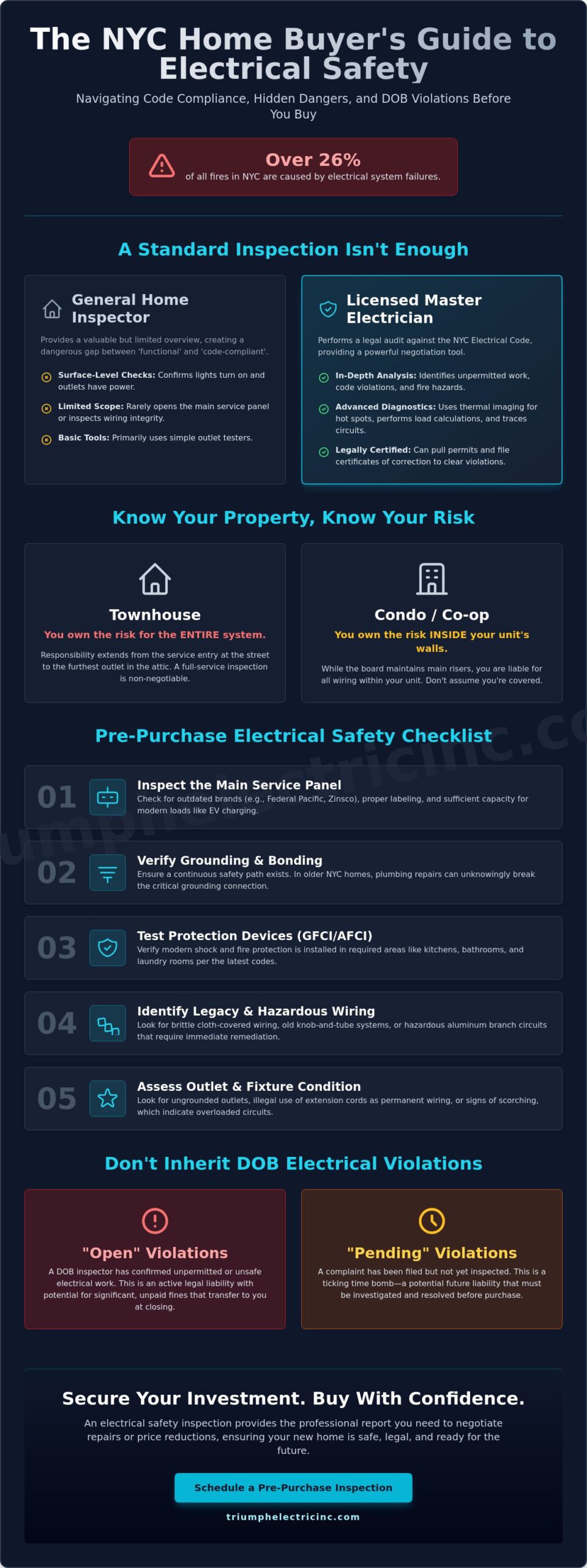
Buying a property in New York City is a high-stakes investment. While a standard home inspection process provides a valuable overview of a building’s general condition, it often lacks the technical depth required to evaluate complex NYC electrical grids. A generalist might confirm that the lights turn on and the outlets have power, but they rarely open the main service panel or inspect the integrity of the wiring behind the walls. This creates a dangerous gap between a system that is merely functional and one that is fully code-compliant. An electrical safety inspection for home purchase nyc bridges this gap by identifying deep-seated issues before you sign the closing papers.
The age of NYC’s infrastructure presents unique challenges. Buildings constructed between the 1920s and 1950s frequently contain cloth-covered wiring. Over decades, this insulation becomes brittle and flakes away; it leaves exposed copper that can lead to arcing or fires. Discovering these hazards after the closing date shifts the entire financial burden of remediation onto you. It’s much easier to negotiate a credit for a necessary upgrade when you have a professional report in hand. Failing to catch these issues early can lead to significant liabilities, especially if the Department of Buildings identifies unpermitted work after you take ownership.
Townhouse vs. Condo/Co-op: Who Owns the Risk?
The nature of your liability depends heavily on the property type. In a townhouse, you are responsible for the entire system, from the service entry at the street to the furthest outlet in the attic. This requires a full-service inspection of the service head, the meter, and the grounding system. In contrast, condo and co-op buyers often assume the building’s board handles all electrical issues. This is a mistake. While the board maintains the main risers, you generally own the risk for all wiring inside your unit’s walls. This is particularly critical in boutique condos where maintenance standards might vary significantly between units.
Master Electrician vs. General Inspector
A Licensed Master Electrician possesses the specific credentials and tools required to evaluate a property’s safety according to the 2025 NYC Electrical Code. While a general inspector uses a simple outlet tester, a specialist employs advanced diagnostics to find hidden dangers. A professional report from a licensed firm serves as a powerful negotiation tool. It provides a clear, factual basis for requesting repairs or a price reduction based on the actual cost of bringing the building up to legal standards.
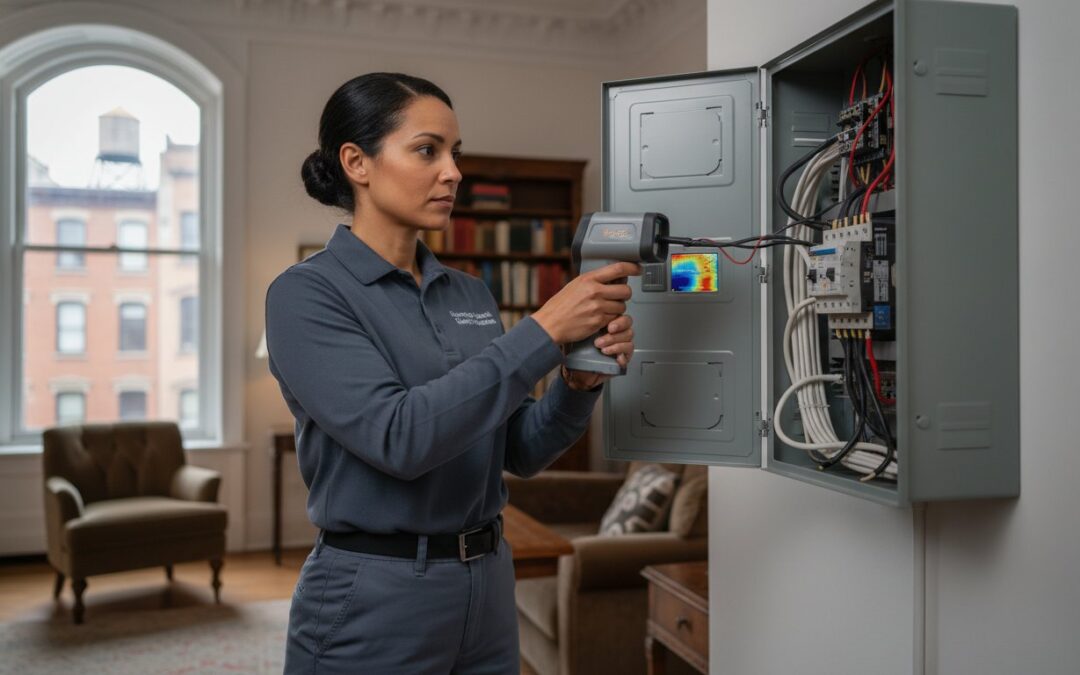
- Thermal Imaging: Identifying “hot spots” in the panel that indicate loose connections or overloaded circuits.
- Load Calculations: Determining if the current service can handle modern appliances without tripping breakers.
- Circuit Tracing: Mapping the system to identify illegal sub-panels or unpermitted additions.
The Comprehensive NYC Home Purchase Electrical Checklist
A structured approach is the only way to ensure nothing is missed during an electrical safety inspection for home purchase nyc. In a city where buildings often feature layers of renovations dating back a century, you can’t rely on visual cues alone. The NYC Electrical Code, updated as of December 21, 2025, sets high standards for new and altered work. Use this five-step checklist to evaluate the safety and legality of any property before you commit to the purchase.
- Step 1: Inspect the Main Service Panel. Check for outdated brands and ensure the panel is properly labeled. Verify there is enough capacity for modern loads.
- Step 2: Verify Grounding and Bonding. Many NYC homes rely on plumbing-connected grounding. Check that recent repairs haven’t broken the continuity of these safety systems.
- Step 3: Test Protection Devices. Ensure GFCI and AFCI protection is present in kitchens, bathrooms, and living areas as required by the 2020 NEC and NYC amendments.
- Step 4: Identify Legacy Wiring. Look for cloth-covered wiring, knob-and-tube remnants, or hazardous aluminum branch circuits.
- Step 5: Assess Outlet Density. If you see extension cords used as permanent wiring, the home likely lacks sufficient circuitry for modern demands.
Panel Inspection: Red Flags and Outdated Brands
Certain brands of electrical panels are known fire hazards. Federal Pacific Electric (FPE) and Zinsco panels are common in older Queens and Brooklyn homes, yet they often fail to trip during a surge. Look for “double-tapping,” where two wires are forced into a single breaker. This is a common violation that causes overheating. If the panel is over 30 years old, it likely needs a professional service upgrade to meet the electrical needs of 2026, including EV chargers and high-efficiency heat pumps.
Wiring and Outlet Safety Standards
Recent “flips” in Manhattan apartments often hide DIY electrical work behind fresh paint. Testing for open grounds and reversed polarity is essential to prevent equipment damage and shocks. Current NYC codes require tamper-resistant outlets in residential units to protect children. If you find standard outlets in a supposedly gut-renovated space, it’s a clear sign that the work was likely performed without a permit. An electrical safety inspection for home purchase nyc will uncover these shortcuts before they become your legal liability.
Evaluating Service Capacity: Con Edison Upgrades and NYC Code
Most NYC properties built before 1970 were originally designed for a 60 or 100 Amp service. While this was sufficient for a mid-century lifestyle, it is often inadequate for the demands of 2026. As you conduct an electrical safety inspection for home purchase nyc, evaluating the total service capacity is just as vital as checking for wire integrity. With the All-Electric Buildings Act now in effect for most new residential constructions under seven stories, the city’s infrastructure is rapidly shifting toward high-demand electrical systems. If your potential home still relies on 100 Amps, you may find yourself unable to run a central air conditioner, an induction range, and a high-speed EV charger simultaneously without tripping the main breaker.
Identifying if a property is “maxed out” requires more than a glance at the panel. Look for a crowded breaker box where every slot is filled, or the presence of “tandem” breakers used to squeeze more circuits into a limited space. Frequent flickering of lights when a heavy appliance kicks in is a classic symptom of a system at its limit. You can use an electrical safety checklist to note these performance issues during your walkthrough. If the property’s load is near its ceiling, a professional Con Edison service upgrade will likely be your first major project after closing.
The 200 Amp Standard for 2026 Home Purchases
Modern NYC renovations now treat 200 Amp service as the baseline requirement. This capacity provides the necessary headroom for future-proof technologies like high-efficiency heat pumps and multiple electric vehicle charging ports. Calculating the cost-benefit of this upgrade during the purchase phase is a smart financial move. It allows you to wrap the infrastructure costs into your initial renovation budget rather than facing a secondary, more disruptive project later. A higher capacity also increases the property’s resale value as NYC continues its transition away from fossil fuels.
Con Edison Requirements and Timelines
Upgrading your service involves a coordinated effort between the utility company and your contractor. A licensed electrician NYC must initiate a “Work Request” through the Con Edison portal to begin the process. This paperwork includes load letters and site plans that detail the new demand. Typical wait times for service increases vary by borough, with Brooklyn and Queens often seeing longer lead times due to high renovation volumes. Your electrician handles the filing and ensures the outdoor service entry and meter placement meet the latest NYC Department of Buildings standards.
Identifying and Clearing Inherited DOB Electrical Violations
In New York City, a property title search doesn’t always reveal the full extent of electrical liabilities. You must perform a deep-dive search into the Department of Buildings (DOB) records to identify any existing infractions. This is a critical component of an electrical safety inspection for home purchase nyc. If you find issues, you’ll need to follow the specific steps for NYC electrical violation removal. Ignoring these records can lead to a “Work Without a Permit” violation. For one- or two-family dwellings, this carries a minimum penalty of $600 and a maximum of $10,000.
Understanding the status of a violation is vital. An “Open” violation means the DOB has identified a hazard or unpermitted work that hasn’t been resolved. A “Pending” status often indicates an active OATH/ECB summons where a hearing is scheduled. If you inherit these, you’re responsible for the fines and the cost of remediation. Legalizing the work requires a Licensed Master Electrician to inspect the system, pull the necessary permits, and file a Certificate of Correction with the city. This process ensures the building is safe and the legal record is clear.
Common DOB Violations Found During Home Purchases
Illegal electrical work is a frequent discovery in the NYC market. Many sellers perform renovations without filing for a Master Electrician permit to save time. This is especially common in Brooklyn multi-family residences, where you might encounter illegal sub-metering setups. Another frequent issue is the failure to provide required fire alarm system wiring in common areas of smaller apartment buildings. These aren’t just safety risks; they’re significant legal hurdles that can halt a sale or lead to massive post-purchase expenses.
The Legal and Financial Risks of Ignoring Violations
Open violations create a “cloud” on the property title. Most mortgage lenders will refuse to fund a loan until these issues are cleared. Similarly, insurance companies may deny coverage if they discover unpermitted electrical systems. As of 2026, the penalties for work performed without a permit have increased significantly. For buildings other than one- or two-family dwellings, the penalty is now 21 times the amount of the permit fee. You should always demand a “Clearance of Violations” and a final sign-off from the seller before signing the contract.
If you’ve discovered active infractions on a property you intend to buy, our team specializes in NYC electrical violation removal to ensure your transition into a new home is seamless and legally sound.
Securing Your Investment with a Licensed NYC Master Electrician
The final stage of your due diligence involves hiring a professional who understands the unique regulatory landscape of the five boroughs. In New York City, homeowners and general contractors are legally prohibited from pulling electrical permits. Only a licensed electrical contracting firm has the authority to file work with the Department of Buildings. When you schedule an electrical safety inspection for home purchase nyc, you aren’t just buying a safety check. You’re securing a legal advocate who can verify the legitimacy of every wire and breaker in the building.
You should always verify a contractor’s credentials through the NYC Department of Buildings portal before they set foot on the property. A valid Master Electrician license is the only guarantee that the inspector has the training to spot code violations that could lead to future fines. A professional report from Triumph Electrical Contracting Inc. provides a line-item breakdown of the system’s condition. This document is a powerful asset during price negotiations. If our inspection reveals significant necessary upgrades or hidden unpermitted work, you can present these findings to the seller to demand a closing credit or a price reduction. Factual data from a licensed expert is difficult for a seller’s agent to ignore.
The Triumph Advantage: NYC-Specific Expertise
Triumph Electrical Contracting Inc. has a long history of clearing complex violations across all five boroughs, from historic brownstones in Brooklyn to modern high-rises in Manhattan. We don’t just identify problems; we provide the professional solutions required to fix them. We handle direct coordination with Con Edison for service upgrades and ensure all new installations meet the strict requirements of the 2025 NYC Electrical Code. Our deep familiarity with local infrastructure allows us to navigate the bureaucracy of the DOB efficiently. We focus on ensuring your property is compliant on the first attempt to avoid the stress of repeated inspections.
Next Steps: Booking Your Pre-Purchase Inspection
Timing is everything in a competitive real estate market. You should schedule your walkthrough as soon as your offer is accepted, ideally during the initial “due diligence” period. To prepare for the inspection, request access to the main service room and any sub-panels from the seller or building management. Access to the building’s recent electrical history or past permit records allows us to provide a more thorough assessment. An electrical safety inspection for home purchase nyc is the final step toward a stress-free closing and long-term peace of mind in your new home.
- Verify Licensing: Check the DOB portal to ensure your electrician is a Licensed Master Electrician.
- Request Access: Ensure all service panels and meters are accessible for the walkthrough.
- Review the Report: Use the documented findings to negotiate repairs or credits before the contract is finalized.
Ensure Long-Term Safety for Your New NYC Home
The journey to property ownership in New York requires more than a simple walkthrough; it demands a rigorous verification of the infrastructure that powers your daily life. By utilizing an electrical safety inspection for home purchase nyc, you move beyond the surface level to address the structural and legal realities of urban living. Whether you are navigating the transition to an all-electric building or resolving inherited Department of Buildings issues, professional oversight ensures your investment remains secure from day one. You deserve to move into your new space with the certainty that every circuit and panel meets the highest safety standards.
Triumph Electrical Contracting Inc. stands as a dedicated guardian of New York’s local infrastructure. As a Licensed NYC Master Electrician, we offer the precise expertise needed to navigate complex DOB and Con Edison regulations. Our commitment to achieving successful outcomes on the first attempt removes the stress of non-compliance and hazardous wiring. We also provide 24/7 emergency service to ensure you are never without support in your new property. Let us help you finalize your purchase with confidence and professional legitimacy.
Schedule your NYC Pre-Purchase Electrical Inspection with Triumph Electrical Contracting Inc. today.
Frequently Asked Questions
Is a separate electrical inspection required for a co-op or condo purchase in NYC?
While a building board maintains the main risers, you’re responsible for the wiring within your unit’s walls. A specialized electrical safety inspection for home purchase nyc is highly recommended to identify unpermitted alterations made by previous owners. These hidden issues can lead to safety hazards or future legal liabilities that the building’s master insurance policy won’t cover.
How much does a professional electrical safety inspection cost for a NYC townhouse?
The cost of an inspection depends on the building’s square footage and the complexity of its electrical systems. Historic townhouses often require more time to evaluate legacy wiring and service entry points compared to modern properties. You should contact a licensed firm to receive a quote tailored to the specific age and size of the building you intend to purchase.
What are the most common electrical red flags in older Brooklyn homes?
Brooklyn properties frequently feature outdated Federal Pacific or Zinsco panels that fail to trip during an overload. You’ll also see ungrounded three-prong outlets that have been installed without a proper ground wire. Illegal sub-panels and “double-tapped” breakers are common in multi-family conversions where owners attempted to expand capacity without filing for the necessary Department of Buildings permits.
Can I buy a house in NYC that has an open electrical violation?
You can legally purchase a property with an open violation, but you inherit the full legal and financial responsibility for clearing it. These infractions stay with the property title rather than the previous owner. Most mortgage lenders and insurance providers will require a Certificate of Correction before they finalize your loan or coverage to mitigate their own risk.
How long does it take for a Master Electrician to complete a home purchase inspection?
A comprehensive electrical safety inspection for home purchase nyc typically takes between one and three hours to complete. This timeframe varies based on the accessibility of the main service panel and the number of circuits being tested. A licensed professional will examine the service entry, panel condition, and a representative sample of outlets and fixtures to ensure the entire system is safe.
Will Con Edison shut off my power if the previous owner had an electrical violation?
Con Edison generally won’t disconnect power for a standard administrative violation. However, they’ll terminate service if the Department of Buildings identifies an immediate life-safety hazard or evidence of illegal meter tampering. If the service entry equipment is found to be dangerously degraded, a licensed electrician must perform repairs and certify the work before the utility company restores power.
What is the difference between an electrical inspection and a load calculation?
An inspection focuses on the current safety and code compliance of the existing wiring and devices. A load calculation is a technical assessment used to determine if the building’s service capacity can handle additional modern demands. You need a load calculation if you plan to install high-draw equipment like electric vehicle chargers, induction ranges, or heat pump systems after your purchase.
Do I need to rewire an entire NYC apartment if it still has cloth-covered wiring?
Cloth-covered wiring is a significant safety concern because the insulation becomes brittle and flakes away over time. While it might still provide power, it no longer meets modern safety standards and poses a high risk of electrical fires. Most licensed professionals recommend a full rewire of these circuits to ensure the property is safe and compliant with the latest NYC codes.