Imagine it is the peak of a July heatwave in Brooklyn and your air conditioner suddenly cuts out just as the room finally begins to cool. You have likely dealt with the frustration of a circuit breaker that trips every time the compressor kicks in. This is more than just a minor inconvenience. A recurring power failure is a clear warning that your electrical system is overloaded, and in older NYC buildings, pushing an aging circuit to its limit creates a genuine risk of electrical fires.
A professional dedicated circuit installation for AC unit nyc is no longer just a recommendation for your comfort; it is a critical safety requirement. Under the 2025 New York City Electrical Code, which took effect on December 21, 2025, proper wiring is essential to meet strict Department of Buildings safety standards. This 2026 guide explains exactly why your cooling setup requires its own line to prevent hazardous overloads and avoid steep penalties for non-compliance. You will learn how to achieve stable, uninterrupted cooling while ensuring your property remains fully compliant with local regulations and the All-Electric Buildings Act.
Key Takeaways
- Understand why the 2025 NYC Electrical Code requires dedicated circuits for high-draw appliances to prevent fire hazards and system overloads.
- Learn how a professional dedicated circuit installation for AC unit nyc ensures reliable cooling without the risk of frequent breaker trips.
- Identify the specific electrical needs for various cooling systems, including window units, mini-splits, and through-the-wall sleeves.
- Discover how to protect your property from costly DOB penalties and the potential need for future electrical violation removal.
- Get an overview of the professional installation steps, from conducting load calculations to identifying the most efficient wiring routes through your home.
Why NYC Apartments Require Dedicated AC Circuits
A dedicated circuit is an electrical line that serves exactly one appliance. It runs directly from your breaker panel to a single outlet without sharing power with any other devices. In the 1920s, NYC apartments were designed for light bulbs and radios. They weren’t built for modern high-draw appliances. Today’s cooling demands are far beyond what pre-war cloth-insulated wiring can handle safely. When you opt for a dedicated circuit installation for AC unit nyc, you’re correcting a legacy infrastructure gap that puts your home at risk. This is particularly true in neighborhoods like the Upper West Side or Brooklyn Heights, where residential wiring often dates back nearly a century.
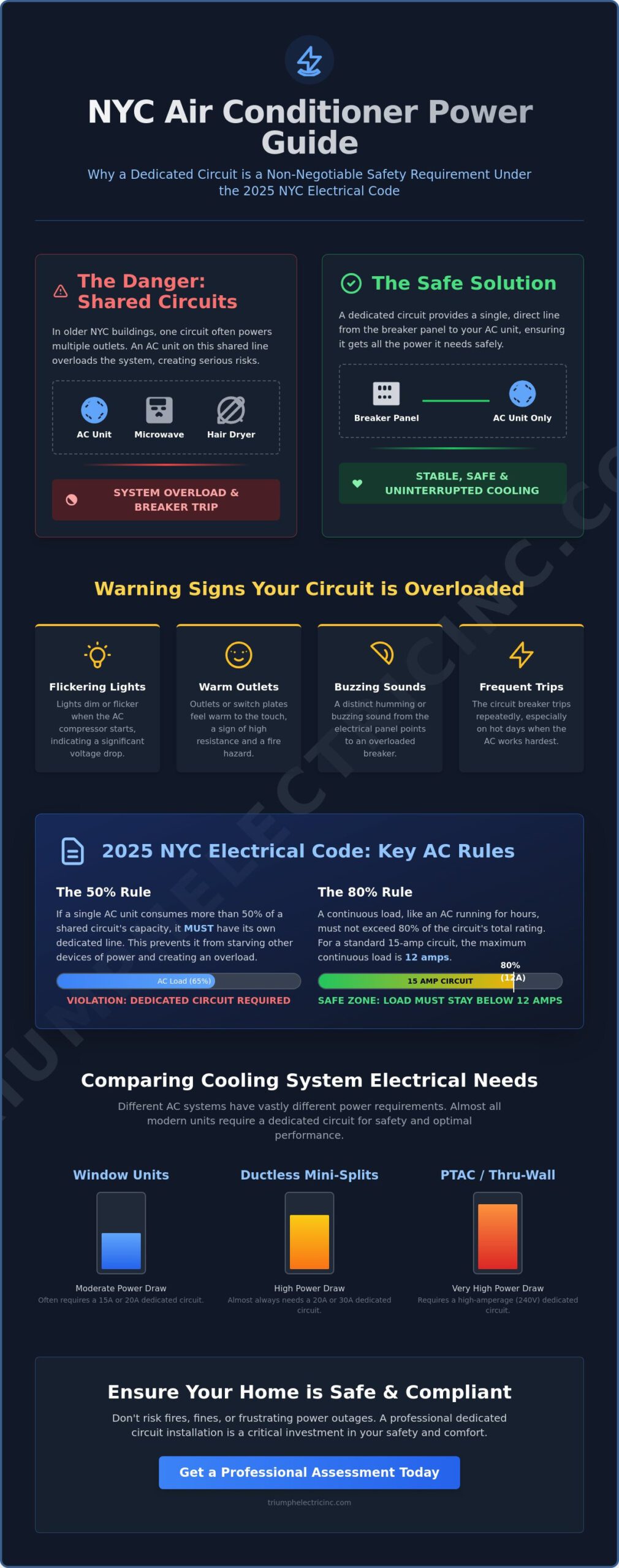
Air conditioners require a massive surge of power to start the compressor. This is called “inrush current.” It can be three to five times higher than the unit’s normal running amperage. If your AC shares a line with other devices, this sudden draw causes voltage drops. You’ll notice immediate indicators that your system is failing to meet electrical wiring safety standards. These warning signs include:
- Flickering lights whenever the compressor kicks in.
- Outlets that feel warm to the touch or show slight discoloration.
- A distinct humming or buzzing sound coming from the electrical panel.
- Frequent circuit breaker trips during the hottest parts of the day.
Warm outlets are especially concerning. They indicate high resistance at the connection point, which is a common precursor to melting and electrical fire. Professional intervention ensures that these symptoms are addressed before they lead to equipment failure.
The Dangers of Shared Circuits in Older Buildings
Manhattan apartments often feature “daisy-chained” outlets. This means several wall plugs are connected in a series on a single circuit. If you run a microwave or hair dryer while the AC is on, the circuit breaker will likely trip instantly. More dangerously, the constant heat generated by overtaxed wires degrades the insulation inside your walls over time. This increases the risk of arcing. Ignoring these issues often leads to the need for NYC electrical violation removal once an inspector identifies the hazard. A dedicated line provides a clean, unobstructed path for power, protecting both your appliance and your building’s integrity.
NYC Power Density and Summer Grid Strain
During NYC heatwaves, the entire city’s power grid experiences extreme stress. Localized voltage drops are common across the five boroughs. If your AC doesn’t have a dedicated line, these fluctuations can damage the sensitive electronics in modern inverter-driven units. These units require stable amperage to maintain their energy-efficient performance. A dedicated line isolates the unit from other residential loads, providing a buffer against the noise and instability of the building’s main power supply. This setup ensures your cooling remains consistent when the outside temperature peaks and the grid is at its most vulnerable. Investing in a dedicated circuit installation for AC unit nyc is the only way to guarantee both performance and safety during a New York summer.
NYC Electrical Code & AC Installation Requirements
Understanding the legal framework is essential for any property owner in the five boroughs. The 2025 NYC Electrical Code, which became effective on December 21, 2025, sets the standard for every dedicated circuit installation for AC unit nyc. While the National Electrical Code (NEC) serves as a baseline, New York City implements specific amendments to address the unique density and aging infrastructure of local buildings. These regulations aren’t suggestions; they are mandatory safety requirements designed to prevent catastrophic failures in high-occupancy residential structures.
One critical requirement involves the capacity of window units. If a single air conditioner consumes more than 50% of a branch circuit’s total capacity, the code requires it to have its own dedicated line. Additionally, the “80% Rule” is a fundamental principle of air conditioner electrical safety. This rule dictates that a continuous load, such as an AC running for hours during a heatwave, should not exceed 80% of the circuit’s rated amperage. For example, a 15-amp circuit should not carry a continuous load greater than 12 amps. Exceeding these limits leads to heat buildup that can degrade wire insulation over time.
For units installed in bedrooms, NYC code mandates Arc-Fault Circuit Interrupter (AFCI) protection. This technology identifies dangerous electrical arcs that standard breakers might miss. By detecting these small sparks before they ignite building materials, AFCI protection provides an extra layer of security for sleeping residents. Ensuring your installation meets these modern standards is the only way to guarantee long-term safety.
Master Electrician Requirements for New Lines
NYC law is clear: only a licensed electrician NYC can legally pull the necessary permits for new circuit installations. For most residential AC projects, a Master Electrician must file a Work Permit (OP128) with the Department of Buildings (DOB). Attempting DIY wiring or hiring unlicensed labor doesn’t just risk a fine. It can also void your property insurance policy if a fire occurs, leaving you liable for damages. If your current setup is already triggering warnings, professional troubleshooting and repair can identify exactly where your system falls short of current code.
Sizing the Circuit: 15 Amp vs. 20 Amp
Correct sizing starts with the wire gauge. A 15-amp circuit typically utilizes 14 AWG wire, while a 20-amp circuit requires thicker 12 AWG wire to handle the increased current. For most modern through-the-wall units in NYC, 20-amp circuits have become the standard to accommodate higher BTU ratings and ensure the system isn’t running at its absolute limit. If you’re installing a mini-split system, the code also requires a dedicated “disconnect” switch located within sight of the outdoor condenser. This allows for safe power termination during maintenance. Selecting the right components during your dedicated circuit installation for AC unit nyc ensures your cooling system operates efficiently without straining your electrical panel.
Comparing Electrical Needs: Window Units, Mini-Splits, and PTACs
Different air conditioning systems place vastly different demands on your home’s infrastructure. A dedicated circuit installation for AC unit nyc is not a one-size-fits-all service. The requirements change based on the cooling technology you choose and the specific BTU rating of the unit. While a small window AC might run on a standard outlet in a modern building, the high-density environment of New York often necessitates specialized wiring to prevent building-wide electrical strain. Understanding these distinctions is the first step toward a safe and efficient installation.
Window air conditioners are the most common cooling solution in the five boroughs. Many residents assume they can simply plug these into any available wall socket. This is a mistake for units exceeding 12,000 BTUs. High-capacity window units pull significant current that can easily exceed the 50% capacity rule for shared branch circuits. Through-the-wall units, often found in post-war “white brick” buildings, are even more demanding. These sleeve-mounted units are designed for permanent placement and typically require a dedicated 208V or 240V line to function correctly over long periods.
Packaged Terminal Air Conditioners (PTACs) and ductless mini-splits represent the higher end of the cooling spectrum. PTAC units are standard in many NYC condos and require high-voltage circuits that must be precisely matched to the unit’s amperage. Ductless mini-splits are becoming the preferred choice for those complying with the All-Electric Buildings Act. These systems are complex; they require a dedicated outdoor disconnect switch for safety and a specific sub-feed to power the indoor air handlers. Proper dedicated circuit installation for AC unit nyc ensures these sophisticated systems don’t suffer from voltage drops that lead to expensive repairs.
Voltage Matters: 120V vs. 208V in NYC
New York City is unique because many residential buildings utilize a three-phase electrical system. This often results in a 208V supply rather than the 240V supply common in suburban single-family homes. If you install an AC motor rated strictly for 240V on a 208V line, the motor will run slower and hotter, leading to premature failure. In buildings where multiple high-capacity units are being added, a Con Edison service upgrade is frequently necessary to ensure the building’s main bus can handle the increased amperage without overheating.
BTUs and Amperage: A Quick Reference
Proper circuit sizing depends entirely on the cooling power of your unit. Use these general guidelines to evaluate your needs:
- 8,000 to 12,000 BTU: These units are the limit for shared 15-amp circuits. They should ideally have a dedicated line if the building wiring is older than 40 years.
- 15,000+ BTU: A dedicated 20-amp line is non-negotiable. These units pull too much current for standard residential outlets.
- Multi-zone systems: You must calculate the total load of all components. The combined amperage must never exceed 80% of the circuit breaker’s rating to ensure continuous operation during heatwaves.
The Installation Process: What to Expect in Your NYC Home
A professional dedicated circuit installation for AC unit nyc follows a disciplined, multi-step protocol to ensure both safety and code compliance. The process begins with a comprehensive load calculation and panel audit. This initial assessment determines if your existing service can handle the additional demand without overloading the main bus. If the capacity exists, the next phase involves pathfinding. In New York City, this is often the most complex stage. Identifying the least invasive route through thick masonry or historic plaster requires a deep understanding of local building archetypes, from pre-war tenements to modern high-rises.
Once the route is established, the physical work begins with running the wiring. Per NYC fire codes, this typically requires armored cable, commonly known as BX, or rigid conduit to prevent mechanical damage and fire spread. After the cable is pulled, the electrician installs a dedicated receptacle specifically rated for your unit’s amperage. Rigorous testing for proper grounding follows to ensure the system is fail-safe. The final step is clear labeling of the circuit at the panel. This transparency is vital for future maintenance and ensures any resident can quickly identify power sources during an emergency.
Working with NYC Building Materials
New York properties present unique structural challenges. Running wire through modern drywall is straightforward, but historic lath and plaster walls are brittle and prone to cracking. In landmarked Brooklyn brownstones where preserving original plaster is a priority, surface-mounted Wiremold is a professional alternative that maintains aesthetic integrity. Additionally, multi-family apartment buildings often feature fire-rated walls. Penetrating these barriers requires specialized fire-stopping sealants to maintain the building’s safety envelope. Navigating these obstacles correctly is what separates a code-compliant installation from a hazardous one.
Panel Upgrades and Sub-panels
Many older NYC panels are already at maximum capacity. If your breaker box has no open slots, a dedicated circuit breaker panel installation is the most reliable solution to modernize your infrastructure. This upgrade provides the necessary room for new AC lines and improves overall home safety. For large lofts or expansive apartments where the AC unit is far from the main service, installing a sub-panel can be a more efficient choice. This reduces the length of wire runs and simplifies future troubleshooting. If you are unsure about your current panel’s capacity, a professional troubleshooting and repair visit can clarify your options before summer begins.
Ensuring Code Compliance and Avoiding DOB Violations
Choosing an unlicensed contractor for a dedicated circuit installation for AC unit nyc often results in costs that far exceed the initial savings. The New York City Department of Buildings (DOB) maintains strict oversight of residential electrical systems to protect high-density housing. As of December 21, 2025, electrical work performed without a permit is subject to severe civil penalties under Article 213 of the NYC Buildings Code. For buildings other than one or two family dwellings, these penalties range from a minimum of $6,000 to a maximum of $15,000. These fines are in addition to the professional NYC electrical violation removal costs required to legalize the work after the fact.
The DOB identifies illegal installations through several channels, including tenant complaints, building-wide inspections, or during the due diligence phase of a property sale. An unpermitted AC circuit is a major red flag that can stall a real estate closing or trigger a full building audit. To finalize a legitimate project, a licensed Master Electrician must obtain a Certificate of Inspection. This document serves as official proof that the installation meets the 2025 NYC Electrical Code. Landlords and co-op boards strictly require this paperwork to maintain their building insurance and shield the corporation from liability.
Clearing Existing Electrical Violations
If you’ve inherited a property with unpermitted wiring or received a ‘Stop Work’ order, an experienced electrical contracting firm must intervene. The legalization process involves a detailed site audit to see if the existing line can be salvaged or if a full replacement is necessary. We handle the technical filings required to dismiss Environmental Control Board (ECB) and DOB fines. Correcting these issues promptly prevents penalties from escalating and ensures your cooling system doesn’t remain a legal liability. Our team focuses on achieving successful regulatory outcomes on the first attempt to resolve these stressors quickly.
Triumph Electrical Contracting Inc.: Your Partner in Code-Compliant Cooling
Triumph Electrical Contracting Inc. understands the unique infrastructure challenges found across all five boroughs. Whether you’re navigating the rigid requirements of a Manhattan landmark board or upgrading a multi-family unit in Queens, we provide the disciplined expertise needed for high-stakes safety projects. Our “First-Time Success” promise is designed to save property owners the anxiety of non-compliance and the wasted expense of failed inspections. We don’t just install wires; we provide the legitimacy and security your property requires. Contact Triumph Electrical Contracting Inc. today for a comprehensive evaluation of your needs and a professional dedicated circuit installation for AC unit nyc that meets every legal and safety standard.
Securing Your Property for the Next NYC Heatwave
Maintaining a safe and efficient cooling system in New York City requires more than just buying a new unit. As the 2025 NYC Electrical Code dictates, proper infrastructure is the only way to prevent fire hazards and ensure long-term reliability. A professional dedicated circuit installation for AC unit nyc removes the stress of frequent power outages and protects your expensive equipment from voltage fluctuations. By prioritizing code compliance now, you avoid the significant financial penalties associated with unpermitted work and Department of Buildings violations.
Triumph Electrical serves as your dependable guardian of local infrastructure. As a Licensed NYC Master Electrician, we specialize in everything from circuit upgrades to complex NYC DOB violation removal. We provide 24/7 emergency support to keep your property powered when you need it most. Our team is disciplined, precise, and committed to getting your project right on the first attempt. Don’t wait for the next heatwave to discover your system’s weaknesses.
Schedule your dedicated AC circuit installation with Triumph Electrical today. Prepare your home for peak summer temperatures with the peace of mind that only professional expertise can provide.
Frequently Asked Questions
Can I use an extension cord for my window AC unit in NYC?
No, you should never use an extension cord to power an air conditioner in New York City. Most extension cords are not rated for the high amperage an AC unit requires, which leads to overheating and potential electrical fires. NYC fire safety standards require these units to be plugged directly into a wall outlet to ensure a secure, high-capacity connection that can handle the unit’s power draw.
How do I know if my AC is already on a dedicated circuit?
You can verify this by turning off the circuit breaker labeled for your air conditioner and checking if any other lights or outlets in the room lose power. If only the AC unit shuts off, it is likely on a dedicated line. A professional dedicated circuit installation for AC unit nyc will always be clearly labeled in your electrical panel to allow for easy identification and safe maintenance.
Does a mini-split AC require a different type of circuit than a window unit?
Yes, mini-split systems have significantly different electrical requirements than standard window units. While many window ACs run on 120V circuits, mini-splits typically require a 208V or 240V dedicated line and a separate outdoor disconnect switch. These systems also involve a specific sub-feed to power the indoor air handlers, making professional wiring essential to meet the 2025 NYC Electrical Code.
What is the average cost of installing a dedicated AC circuit in Manhattan?
Costs for electrical work in Manhattan vary depending on the complexity of the wire run and the age of the building’s infrastructure. While national averages exist for basic installations, NYC projects often involve navigating historic masonry or fire-rated walls which affects the total investment. You should consult a licensed professional for a specific evaluation that accounts for your building’s unique structural challenges.
Why does my breaker trip only when the AC compressor starts up?
Your breaker trips because the “inrush current” required to start the compressor exceeds the circuit’s capacity. This initial surge can be three to five times higher than the unit’s normal running amperage. If the circuit is already shared with other devices or the wiring is undersized, the breaker will trip immediately to prevent the wires from overheating and causing a fire inside your walls.
Is it legal to install my own AC circuit if I own my NYC home?
No, it is not legal for a homeowner to install new electrical circuits in New York City. All new wiring and circuit additions must be performed by a Licensed Master Electrician who can file the necessary Work Permit with the Department of Buildings. Attempting DIY electrical work can result in significant civil penalties and may void your homeowner’s insurance policy if a fire occurs.
What happens if I ignore a DOB violation for illegal electrical wiring?
Ignoring a Department of Buildings violation leads to escalating civil penalties that can reach $15,000 for multi-family buildings. The DOB may also issue a “Stop Work” order or place a lien on your property, which prevents you from selling or refinancing. Unresolved violations remain a matter of public record until a professional performs the necessary dedicated circuit installation for AC unit nyc and clears the record.
Do I need a new electrical panel to add a dedicated AC line?
You only need a new panel if your current breaker box is at maximum capacity or lacks the physical space for a new breaker. An electrician will perform a load calculation to see if your existing service can handle the additional demand. In many older NYC apartments, a panel upgrade is necessary to safely support modern, high-efficiency cooling systems without overtaxing the main electrical bus.