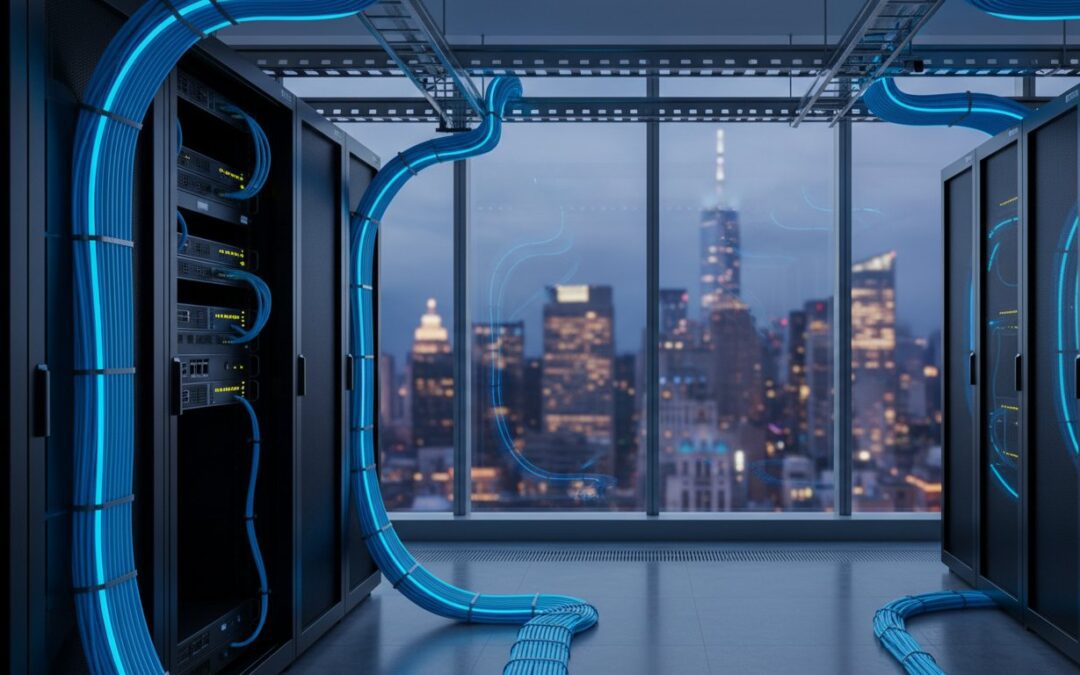
In the high-stakes environment of a Manhattan high-rise, a single hour of network downtime can cost your business more than the entire physical infrastructure that supports it. You already know that reliable connectivity is the lifeblood of your operations, but the reality of local real estate makes achieving it a complex technical challenge. Between the mandatory requirements of Local Law 128 of 2024 and the physical constraints of historic Midtown buildings, installing data cabling for office space manhattan requires more than just pulling wire. It demands a precise understanding of NYC building codes and the latest 2026 energy standards.
We’ll help you secure a network that’s both compliant and future-proof. This guide provides a clear roadmap to building a high-speed, 10-gigabit infrastructure that satisfies every NYC DOB and fire code regulation. You’ll learn why Cat6A is the new baseline for 2026, how to coordinate logistics with building management in high-density districts, and the specific steps required to ensure your system remains scalable for the next ten years.
Key Takeaways
- Understand the technical differences between Cat6, Cat6A, and Fiber Optics to select the correct bandwidth capacity for your specific business operations.
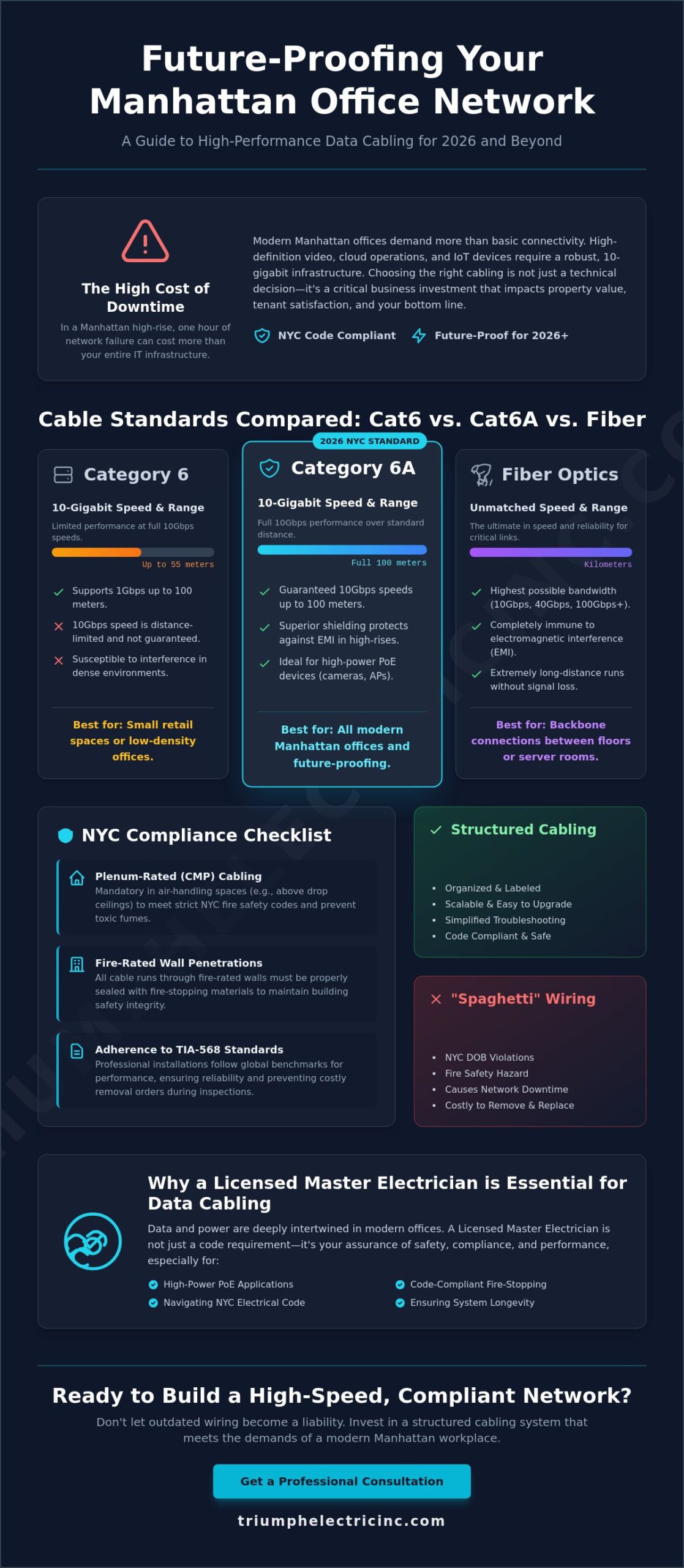
- Ensure your data cabling for office space manhattan meets strict NYC Electrical Code standards, including the mandatory use of plenum-rated (CMP) materials in air-handling spaces.
- Learn how to calculate ideal port density and conduct a site survey to identify efficient cable paths within complex Manhattan building structures.
- Discover the safety advantages of using a Licensed Master Electrician to manage high-power PoE applications and ensure code-compliant penetrations through fire-rated walls.
Why High-Performance Data Cabling is Essential for Manhattan Offices
By 2026, the standard 1Gbps connection has become a bottleneck for Manhattan’s hybrid workplaces. High-definition video conferencing, massive cloud backups, and real-time data syncing demand more throughput than ever before. Professional data cabling for office space manhattan isn’t just a technical utility; it’s a foundational asset that directly impacts your bottom line. A robust network infrastructure increases the market value of commercial real estate. Modern tenants prioritize “plug-and-play” readiness. If your space lacks a high-performance backbone, you risk longer vacancies or reduced lease appeal.
The hidden costs of “shadow IT” and DIY wiring are significant. In a commercial Manhattan lease, uncertified cable runs often lead to costly removals during building inspections. Professional installations strictly adhere to TIA/EIA standards, specifically TIA-568. These global benchmarks ensure that every component, from the patch panel to the individual wall jack, operates within specified performance parameters. Following these rules eliminates the guesswork and technical debt associated with substandard setups.
The High Stakes of Manhattan Connectivity
In Midtown and the Financial District, network latency is more than an inconvenience. For financial services and creative agencies, a millisecond delay in trade execution or a stuttering client presentation can result in lost revenue. High-density environments like Hudson Yards present unique challenges. The sheer volume of electronic signals in these towers requires superior shielding to prevent electromagnetic interference. Additionally, 2026 smart offices rely on a vast network of IoT devices. These sensors manage occupancy lighting and climate control, and they all require a stable, wired connection to function reliably.
Structured Cabling vs. Point-to-Point Wiring
A professional structured cabling system organizes your network into manageable, standardized modules. This approach stands in stark contrast to point-to-point “spaghetti” wiring. Messy, unlabelled cables are more than just an eyesore; they are often a primary cause of NYC DOB violations and fire safety concerns. By implementing a centralized Main Distribution Frame (MDF), you create a single, organized point of control for your entire office. This design simplifies troubleshooting and makes future hardware upgrades seamless. When planning a new layout, choosing an electrical contracting firm that understands the intersection of power and data is the best way to ensure your infrastructure remains compliant and efficient for years to come.
Comparing Cable Standards: Cat6 vs. Cat6a vs. Fiber Optics
Selecting the correct hardware for data cabling for office space manhattan requires a balance between current needs and future scalability. The cable you install today must support the bandwidth requirements of 2030 and beyond. While older standards like Cat5e are now obsolete for commercial use, the choice between Cat6, Cat6a, and Fiber Optics depends on your floor plan’s size and your industry’s specific data demands.
Cat6 remains a viable baseline for smaller Manhattan boutiques or retail spaces. It supports 1GBASE-T up to 100 meters. However, its 10Gbps performance is limited to approximately 55 meters. For larger Midtown offices, this distance is often insufficient. Cat6a has emerged as the 2026 industry standard. It supports 10Gbps speeds over the full 100-meter run and offers superior heat dissipation for high-power PoE devices. For backbone connections between server rooms or across multiple floors, Fiber Optics provide the necessary bandwidth and immunity to interference that copper cannot match.
Is Cat6a Worth the Investment in 2026?
The short answer is yes. In a Manhattan high-rise, your network cables share space with heavy electrical lines and countless wireless signals. Shielded Cat6a cabling is specifically designed to mitigate this electromagnetic interference. It ensures that your data packets reach their destination without corruption. When you consider that labor typically accounts for 60-70% of a cabling project’s total cost, saving a small amount on Cat6 material is often a poor financial decision. It’s much more cost-effective to install Cat6a now than to rip out and replace substandard wiring in three years. All installations must remain in strict alignment with Manhattan building and electrical codes to ensure long-term safety and compliance.
Fiber Optic Integration for Large Manhattan Workspaces
Large-scale workspaces often require a hybrid approach. While copper cables connect individual workstations, fiber optic backbones link the Main Distribution Frame (MDF) to Intermediate Distribution Frames (IDFs) on different floors. Multi-mode fiber is the common choice for these internal runs. It supports high-speed uplinks of 40Gbps or even 100Gbps. If your firm handles massive data sets, such as architectural renderings or high-frequency trading data, fiber is a necessity. For businesses planning a major renovation, choosing an electrical contracting firm that understands these infrastructure requirements ensures your network can handle future growth without bottlenecking.
Navigating Manhattan Building Codes and Plenum Requirements
Manhattan’s regulatory environment is uniquely rigorous. While national standards provide a baseline, the NYC Electrical Code, updated via Local Law 128 of 2024, imposes much stricter safety mandates. Failure to comply leads to costly project delays and significant safety hazards. Every project involving data cabling for office space manhattan must account for these local nuances from the initial design phase to ensure a successful inspection.
The most common oversight in NYC office renovations is the use of Riser-rated (CMR) cable in spaces where Plenum-rated (CMP) cable is legally required. Most Manhattan commercial buildings utilize the space above drop ceilings as a return air plenum for the HVAC system. In the event of a fire, standard PVC cable jackets release highly toxic smoke that the ventilation system quickly distributes. CMP cable uses specialized fire-retardant plastics that emit minimal smoke. This is a critical life-safety requirement in high-density towers where evacuation takes longer.
Managing these technical requirements involves more than just selecting the right wire. Securing the necessary work permits and ensuring total compliance requires the expertise of a licensed electrician NYC. This professional ensures that every penetration through fire-rated walls is properly sealed with approved firestopping materials. Taking these steps protects the building’s integrity and your business’s liability.
NYC Fire Codes and Low-Voltage Wiring
The FDNY and the Department of Buildings (DOB) view low-voltage cabling as a potential fire path if it’s not installed correctly. Beyond the cable jacket material, installers must maintain the structural integrity of fire-rated partitions. Professional installations utilize penetration firestopping. This process involves sealing gaps with specialized intumescent caulks or pillows. These materials expand when exposed to heat. This action prevents smoke and flames from migrating between office suites or floors during an emergency.
Dealing with Landmark Buildings and High-Rise Restrictions
Manhattan’s iconic architecture, such as the Woolworth or Flatiron buildings, presents unique physical constraints. Thick stone walls and intricate historic moldings often forbid standard drilling or surface-mounted raceways. Additionally, high-rise building management teams require specific Certificates of Insurance (COI) before granting access to vertical risers. Whether your building follows Union or Non-Union labor requirements, proactive coordination with the property manager is essential to avoid unexpected project shutdowns or fines.
5 Steps to Planning Your Manhattan Office Cabling Project
Planning a network infrastructure in a Manhattan high-rise requires more than just a floor plan. It demands a disciplined, five-step approach to ensure your system handles the 10Gbps requirements of 2026. A successful project starts with a comprehensive site survey. We identify existing cable pathways, potential obstructions in historic masonry, and the condition of vertical risers. In Manhattan’s high-density towers, coordinating with building management for elevator and loading dock access is a logistical necessity that you must address before the first reel of cable arrives on-site.
Determining port density is the next critical phase. You need to calculate the exact number of drops required for workstations, conference rooms, and common areas. While wireless connectivity is essential, a hardwired backbone remains the only way to guarantee interference-free performance. Your server room or closet layout must also prioritize airflow and dedicated power. In the tight footprints of Midtown offices, efficient rack placement is vital for long-term hardware health. Budgeting for these projects must account for the fact that labor typically represents 60-70% of the total cost. If your survey uncovers abandoned, non-compliant wiring from a previous tenant, you must factor in NYC electrical violation removal to bring the space up to current code. Finally, never consider a project complete without post-installation testing and certification to secure your 25-year manufacturer warranty.
Calculating Your Port Density and Growth
We recommend the “Rule of Two” for modern office design. Every workstation should have at least two data drops to support a primary computer and a VoIP phone or secondary device. You also need to account for high-capacity wireless access points (WAPs), network printers, and specialized IoT sensors. Planning for a 20% growth margin is a standard professional practice. It’s far more cost-effective to pull extra lines during the initial installation than to pay for a separate service call when you add three new employees next year.
The Importance of Cable Certification
There’s a significant difference between basic continuity verification and full cable certification. Certification proves that your data cabling for office space manhattan meets the rigorous TIA/EIA performance standards for 10G networks. We use specialized Fluke testers to measure “Near-End Crosstalk” (NEXT) and Return Loss. These metrics identify subtle interference issues that cause intermittent slowdowns. A professional contractor provides a detailed PDF report for every single drop. This document is your proof of a high-speed, reliable infrastructure. If you’re ready to upgrade your infrastructure, our team can help you with expert data and voice cabling services that meet all NYC standards.
Why a Licensed Master Electrician is the Best Choice for Data
Master Electricians are increasingly essential for modern IT infrastructure. As data cables now carry significant electrical power through Power over Ethernet (PoE), the line between low-voltage and high-voltage work has blurred. Choosing a professional electrical contracting firm ensures that your network isn’t just fast, but fundamentally safe. While an AV firm might understand signal integrity, they often lack the licensing to perform the heavy-duty conduit runs or electrical panel modifications required in complex Manhattan high-rises. Our team provides the disciplined oversight necessary to handle these high-stakes installations correctly the first time.
Triumph Electrical approaches every project with the precision of a Licensed NYC Master Electrician. We integrate high-speed data cabling for office space manhattan with your core power systems to prevent circuit overloads and fire hazards. This oversight is particularly critical when dealing with the dense infrastructure of Midtown or the Financial District, where building codes are strictly enforced. We manage the entire process, ensuring that every data drop and power feed aligns with the latest 2026 safety standards. This methodical approach removes the anxiety of non-compliance and guarantees a reliable infrastructure for your business.
PoE Lighting and Advanced Office Tech
Modern Manhattan offices are transitioning to high-wattage PoE++ (Type 4) cabling to power everything from LED lighting to sophisticated security cameras. These bundles generate significant heat. If they aren’t managed correctly within cable trays or conduits, they lead to performance degradation or even fire risks. We ensure your existing electrical panels have the capacity to support these growing IT rack demands. This proactive strategy prevents the circuit trips and hardware failures that often plague offices with uncertified wiring. We prioritize safety and legitimacy in every bundle we pull.
The Triumph Advantage in Manhattan
Our deep familiarity with local infrastructure allows us to handle complex Con Edison service upgrades required for energy-intensive server rooms. We navigate the specific requirements of Manhattan building management and secure all necessary DOB permits without the hidden complications of less experienced contractors. This localized expertise ensures your project stays on schedule and within legal boundaries. For a reliable, high-speed network that meets every legal and technical standard, contact Triumph Electrical for a comprehensive Manhattan office data cabling quote.
Secure Your Office Infrastructure for the Next Decade
Manhattan’s commercial landscape moves fast. Your network must keep pace. Selecting the right hardware is only half the battle. It’s essential to ensure your data cabling for office space manhattan meets the strict requirements of Local Law 128 and NYC fire codes. By prioritizing Cat6A or fiber backbones now, you avoid the high costs of retrofitting and the anxiety of technical downtime later. A methodical approach to planning ensures your system remains scalable as your business grows.
We provide the disciplined expertise of a Licensed NYC Master Electrician to manage every detail of your installation. Our team delivers code-compliant installations guaranteed to pass inspection, backed by the reliability of 24/7 emergency support. Don’t leave your connectivity to chance in a high-stakes environment where downtime is not an option.
Schedule a Professional Data Cabling Site Survey with Triumph Electrical to secure your infrastructure. We’re ready to help you build a reliable, high-speed foundation for your Midtown or Downtown workspace.
Frequently Asked Questions
Do I really need Plenum-rated cable for my Manhattan office?
Yes, you must use plenum-rated (CMP) cable if your office uses the space above a dropped ceiling for air circulation. This is a mandatory NYC building code requirement. Standard PVC cables release toxic smoke during a fire, which the HVAC system can quickly distribute. Using CMP cable ensures your installation remains code-compliant and prioritizes the safety of your employees in a high-density environment.
What is the difference between Cat6 and Cat6a for a business environment?
Cat6a is the superior choice for 2026 because it supports 10Gbps speeds over the full 100-meter distance. Standard Cat6 is limited to much shorter runs for high-speed data. Cat6a also features enhanced shielding that protects your network from the electromagnetic interference common in Manhattan high-rises. Investing in Cat6a now prevents the need for a costly infrastructure overhaul in the next few years.
How long does a typical office data cabling installation take in NYC?
Most standard office projects take between three to seven business days to complete. The exact timeline depends on the total number of drops and the complexity of your building’s architecture. In Manhattan, logistics like loading dock scheduling and freight elevator availability often dictate the pace of work. We coordinate with your building management early in the process to minimize operational delays.
Can I run data cables in the same conduit as electrical wires?
No, running low-voltage data cables in the same conduit as high-voltage electrical lines is a violation of the NYC Electrical Code. This practice creates significant signal interference that leads to dropped packets and slow network speeds. It also presents a safety hazard. Professional installers always maintain proper separation between power and data lines to ensure both system integrity and regulatory compliance.
Why should I hire a licensed electrician instead of an IT company for cabling?
Licensed Master Electricians have the specific credentials required to pull NYC DOB permits and perform the structural penetrations needed for conduit runs. Many IT companies aren’t licensed to handle the electrical safety aspects of modern PoE lighting or firestopping mandates. Hiring a licensed professional ensures that your project meets all legal standards and passes every safety inspection on the first attempt.
What is structured cabling, and why is it better than standard wiring?
Structured cabling is a methodical approach to infrastructure that organizes your network into a centralized, standardized system. It replaces messy, point-to-point “spaghetti” wiring with an organized Main Distribution Frame (MDF). This architecture is better because it simplifies troubleshooting, supports future hardware upgrades, and significantly increases the long-term real estate value of your commercial office space.
How much does data cabling for office space in Manhattan typically cost?
The total investment for data cabling for office space manhattan depends on variables like the number of workstations, the chosen cable grade, and specific building constraints. Factors such as after-hours labor requirements or the need for historic building protections also influence the final estimate. We provide detailed quotes after a site survey to ensure you understand the full scope of your project requirements.
Does my office cabling need to be certified after installation?
Yes, professional certification is the only way to verify that your network meets strict TIA/EIA performance standards. We use specialized Fluke testers to provide a detailed report for every cable run in your office. This documentation is essential for securing long-term manufacturer warranties. It also provides the peace of mind that your infrastructure can handle the high-speed demands of modern 10Gbps hardware.