Did you know that while commercial electricity rates jumped by an average of 7% in 2025, New York simultaneously sunset its statewide lighting incentives at the end of that year? This shift leaves many business owners questioning if they’ve missed the window for a commercial lighting upgrade rebate nyc. You likely feel the weight of rising Con Edison rates and the strict demands of Local Law 97 compliance. It’s a stressful environment where a single paperwork error or technical oversight can cost your business thousands in lost incentives and future penalties.
We understand that you need a reliable path to modernization that doesn’t compromise your bottom line. This guide provides the clarity required to secure remaining Con Edison funding that can still cover up to 50% of your total project costs. You’ll learn how to navigate the new focus on energy-savings-based rewards and how to qualify for the 22% increase in LED-to-LED upgrade incentives. We’ll preview the essential steps for full rebate approval on your first attempt, helping you slash monthly utility bills and refresh your facility’s aesthetics with total confidence.
Key Takeaways
- Identify how Con Edison CIEE and Custom Programs provide cash incentives to offset up to 50% of your energy-saving project costs.
- Understand the critical role of Local Law 97 compliance in driving the urgency for modernized, high-efficiency lighting systems.
- Learn why selecting DLC-qualified equipment is a non-negotiable requirement for securing a commercial lighting upgrade rebate nyc.
- Follow a proven five-step roadmap, starting with a professional energy audit, to ensure full rebate approval on your first attempt.
- Protect your financial investment by ensuring all work meets NYC DOB codes and rebate eligibility standards through licensed professional installation.
Understanding the NYC Commercial Lighting Rebate Landscape in 2026
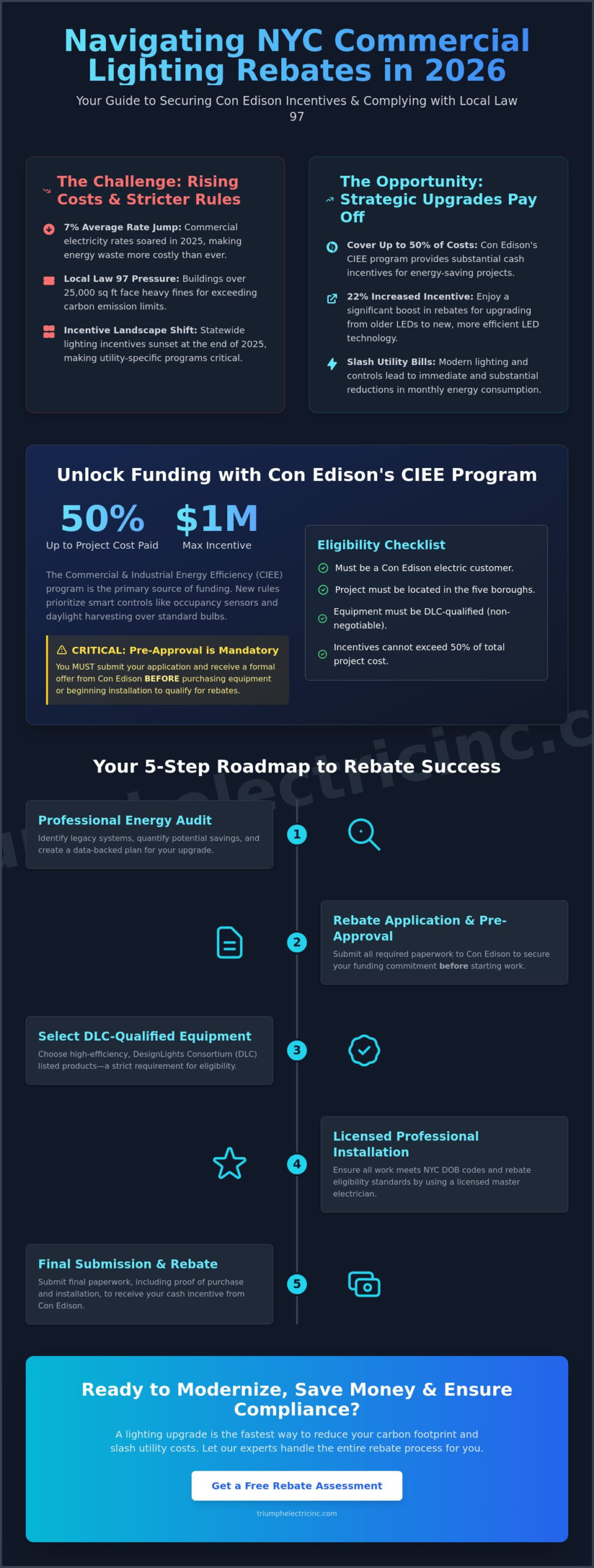
Commercial lighting rebates are financial incentives provided by utilities and state agencies to offset LED installation costs. These programs act as a strategic subsidy, allowing property owners to modernize their facilities while significantly reducing the initial capital investment. In 2026, the landscape has shifted. While statewide incentives for commercial lighting sunset at the end of 2025, the Con Edison Commercial and Industrial Energy Efficiency (CIEE) program remains a vital resource for New York City businesses. This program supports broader initiatives for Energy conservation in the United States by providing cash rewards for high-efficiency equipment. Current rebate tiers now prioritize “smart” networked lighting controls over standard LED bulbs, rewarding systems that use occupancy sensors and daylight harvesting to maximize savings.
Why NYC Businesses Are Upgrading Now
Con Edison’s 2026 rate adjustments have placed a heavier burden on commercial overhead, making energy waste more expensive than ever. Lighting is the fastest, most accessible way to reduce a building’s carbon footprint without the structural disruption of HVAC overhauls. Beyond the numbers, high-CRI LED systems transform retail and office environments. These systems improve color accuracy and employee productivity while reducing eye strain. Many owners use a commercial lighting upgrade rebate nyc to fund recessed lighting installation, trading outdated, flickering tubes for a professional and modern aesthetic.
Local Law 97 and Your Lighting Strategy
For buildings over 25,000 square feet, the era of voluntary upgrades is over. Local Law 97 (LL97) imposes strict carbon emission limits that carry heavy annual fines for non-compliance. In the context of lighting, LL97 compliance requires building owners to adhere to specific energy use intensity limits that restrict the total wattage consumed per square foot across the facility. Professional energy audits are now a necessity to identify legacy systems that pull too much power. By leveraging available rebates, you can replace these non-compliant systems and avoid the financial penalties that will only increase as the city’s carbon caps tighten in the coming years.
Securing these incentives requires precision and adherence to strict utility standards. We focus on achieving successful regulatory outcomes on the first attempt, ensuring your paperwork is as flawless as the technical work. Whether you need service upgrades to support a new lighting layout or a full panel installation, our team ensures your project meets every local code and rebate requirement.
Key Rebate Programs: Con Edison CIEE and NYSERDA Incentives
Securing a commercial lighting upgrade rebate nyc in 2026 requires a clear understanding of the two primary funding streams available to local businesses. While certain statewide lighting incentives sunsetted recently, Con Edison and NYSERDA continue to offer robust financial support for projects that demonstrate measurable energy reduction. These programs generally fall into two categories: prescriptive and custom. Prescriptive rebates provide a fixed, “per-unit” payment for standard equipment like LED troffers. Custom rebates are more complex but often more rewarding. They calculate incentives based on total watts saved, making them the preferred choice for facilities integrating advanced technologies like occupancy sensors and daylight harvesting.
Con Edison CIEE Program Details
The Commercial and Industrial Energy Efficiency (CIEE) program is the backbone of NYC lighting incentives. To qualify, you must be a Con Edison electric customer within the five boroughs. The program offers significant financial backing, with total incentives capped at $1 million for electricity-saving measures. It’s critical to remember that these incentives cannot exceed 50% of the total project cost. One of the most rigid requirements is the pre-approval phase. You must submit your application and receive a formal offer from Con Edison before you purchase any equipment or begin installation. If you’re planning a large-scale project, you might find that your current panel is insufficient. In such cases, professional circuit breaker panel installations or service upgrades are necessary to support the new high-efficiency system while maintaining safety standards.
NYSERDA and Multifamily Lighting Incentives
NYSERDA complements utility programs by offering technical assistance and specialized funding for specific sectors. Their FlexTech program is particularly valuable for the planning phase. It covers 50% of the cost for an energy study, with a maximum of $50,000 for single-fuel studies. This study provides the data needed to justify custom rebate applications. For property owners in Brooklyn and Queens, NYSERDA often targets multifamily common areas with dedicated incentives. These programs encourage “stacked” benefits, where lighting improvements are bundled with other weatherization efforts for a higher total payout. Navigating the various NYSERDA lighting and controls programs is simpler when you coordinate with an approved partner. This ensures your project aligns with state efficiency goals and maximizes your return on investment.
Calculating Your ROI: Energy Savings vs. Installation Costs
Legacy lighting systems like T12 fluorescents or HID lamps act as a continuous drain on your operating budget. While the initial price of a retrofit might seem high, the financial math in New York City favors immediate action. A commercial lighting upgrade rebate nyc through the Con Edison CIEE program can cover up to 50% of your total project costs. This incentive drastically shortens the payback period, often turning a multi-year investment into one that pays for itself in less than 24 months. By reducing the total wattage required to illuminate your facility, you immediately lower your exposure to Con Edison’s rising commercial rates.
Accurately calculating your return on investment requires accounting for NYC-specific variables that generic calculators often miss. You must factor in local labor rates and the specific costs associated with the legal disposal of old mercury-containing bulbs and ballasts. Despite these “hidden” expenses, the combination of utility incentives and state-level support makes the transition financially sound. You can find detailed breakdowns of these funding structures through the NYSERDA Lighting and Controls Incentives portal, which helps business owners align their installation plans with current rebate tiers.
Payback Period Analysis for NYC Offices
In high-density Manhattan office environments, lighting often accounts for a significant portion of total energy consumption. For facilities that operate on a 24/7 basis, the ROI timeline is even more aggressive because the energy savings accumulate around the clock. Modern systems also leverage advanced controls to maximize efficiency. Daylight harvesting systems use photosensors to automatically dim artificial lights when natural sunlight is sufficient, effectively reducing active wattage in glass-fronted buildings. These savings, combined with a 50% rebate, ensure that your capital is recovered quickly while your building value increases.
Maintenance Savings: Beyond the Electric Bill
The financial benefits of an upgrade extend far beyond the monthly utility statement. Standard LED fixtures offer lifespans of 50,000 hours or more, which is nearly five times longer than traditional bulbs. For retail spaces with high ceilings or complex recessed lighting installations, this eliminates the recurring cost of specialized labor and equipment rentals for frequent replacements. Additionally, LEDs emit significantly less heat than legacy systems. This reduction in heat output lowers the “cooling load” on your HVAC system during humid NYC summers, providing a secondary layer of energy savings that further improves your long-term ROI.
The 5-Step Process to Securing Your Lighting Rebate
Securing a commercial lighting upgrade rebate nyc involves a methodical approach that aligns technical installation with strict administrative requirements. You cannot simply swap bulbs and expect a check. The process requires a bridge between utility efficiency standards and NYC Department of Buildings (DOB) safety codes. Following a disciplined roadmap ensures that your project remains eligible for maximum funding while avoiding the legal risks of non-compliant work. This structured path minimizes the stress of the application process and guarantees that your energy savings are documented accurately from day one.
- Step 1: Professional Energy Audit. Establish your baseline by documenting existing wattage, fixture counts, and annual hours of operation. Con Edison offers incentives that cover 50% of the cost for these pre-approved studies.
- Step 2: DLC-Qualified Equipment Selection. Verify that every proposed fixture appears on the DesignLights Consortium (DLC) list. Equipment not found in this database is almost always ineligible for prescriptive rebates.
- Step 3: Pre-Approval Application. Submit your detailed technical specifications and photometric data to the utility. You must receive a formal incentive offer before any equipment is purchased.
- Step 4: Licensed Installation. Execute the project using a qualified contractor. In NYC, commercial work must be performed by a professional who understands local electrical codes and permit requirements.
- Step 5: Final Inspection. Complete the utility walkthrough and submit your disposal manifests to trigger the disbursement of your rebate check.
Navigating the Pre-Approval Phase
Never buy fixtures before the utility signs off on your project. In 2026, the Con Edison approval queue can take several weeks to process. Buying early is a common mistake that leads to immediate disqualification if the equipment fails to meet specific efficiency tiers. Application rejections in NYC often stem from minor technical errors, such as submitting specs for non-DLC products or failing to account for specific ballast types. We focus on achieving successful regulatory outcomes on the first attempt, ensuring your paperwork reflects the exact requirements of the current rebate cycle.
Post-Installation Verification
Utility inspectors perform final walk-throughs to ensure the installed system matches the pre-approved application. They look for specific model numbers and verify that old, inefficient lamps were removed. You must provide a complete documentation package, including itemized invoices, manufacturer spec sheets, and legal disposal manifests. For comprehensive audit support and to ensure your facility meets all current standards, consult a Licensed Electrician NYC. If you need to clear existing issues before starting your upgrade, our team specializes in electrical violation removal to ensure your project proceeds without any regulatory delays.
Why a Licensed NYC Master Electrician is Your Best Rebate Asset
The NYC Building Code requires a Licensed Master Electrician to pull permits and oversee all commercial electrical work. This isn’t just a safety suggestion; it’s a legal mandate that protects your property and your investment. When you apply for a commercial lighting upgrade rebate nyc, Con Edison and NYSERDA require proof that the work meets all local standards. Unlicensed work often leads to immediate incentive disqualification during the final inspection phase. You shouldn’t risk a five-figure rebate by cutting corners on professional labor. A licensed professional provides the technical signatures and license numbers required to move your application from the “pending” queue to the “disbursed” status.
Safety and longevity are the primary goals of any professional retrofit. High-density LED arrays require precise circuit balancing to prevent overloading your existing infrastructure. If your system is poorly designed, you might face frequent tripping or premature component failure. A master electrician ensures that your new fixtures don’t trigger an NYC electrical violation by adhering to the latest National Electrical Code (NEC) standards. This level of discipline ensures your lighting performs as expected for its entire 50,000-hour lifespan without requiring constant troubleshooting.
Avoiding Electrical Violations During Upgrades
Some contractors promise “fast” installs that bypass NYC building permits to save time. These shortcuts often result in severe penalties and stop-work orders from the DOB. Triumph Electrical handles the complex paperwork for both the Department of Buildings and your utility provider. We ensure proper grounding and the seamless integration of emergency lighting systems per NYC code. This proactive approach removes the stress of non-compliance. It also guarantees that your facility is ready for any surprise municipal inspection during or after the upgrade process.
The Triumph Advantage for NYC Businesses
Our team brings extensive experience with Con Edison service upgrades and large-scale commercial lighting projects. We understand that NYC businesses operate on tight schedules and cannot afford significant downtime during a retrofit. Our personality is defined by constant availability and readiness, ensuring we provide around-the-clock support for critical infrastructure. We focus on achieving successful regulatory outcomes on the first attempt so you can focus on your business operations. Whether you need recessed lighting installation or a full panel upgrade, we deliver disciplined, professional results that secure your financial incentives.
Contact Triumph Electrical for a Commercial Lighting Audit to establish your baseline and start your rebate application today.
Take Action to Secure Your Rebate and Modernize Your Infrastructure
Modernizing your facility is a critical step toward long-term operational survival in a city with rising energy costs and strict carbon limits. By leveraging a commercial lighting upgrade rebate nyc, you can offset up to 50% of your installation costs while ensuring full compliance with Local Law 97. We have explored how the 2026 landscape prioritizes networked controls and how a structured 5-step process protects your financial incentives from administrative rejection. Success in this high-stakes environment requires a partner who understands the intersection of utility paperwork and municipal safety codes.
As Licensed NYC Master Electricians and NYC DOB code compliance specialists, we provide the expertise needed for flawless Con Edison CIEE filing and professional installation. Our team manages every technical detail to guarantee your project meets all regulatory standards on the first attempt. Whether you require service upgrades or a complete panel installation, we ensure your transition to high-efficiency power is seamless and secure. Schedule your NYC Commercial Lighting Audit with Triumph Electrical to establish your energy baseline and claim your incentives today. Your path to lower utility bills and a modernized facility is just one professional assessment away.
Frequently Asked Questions
What is the maximum rebate I can get for commercial lighting in NYC?
The maximum incentive for electricity-saving projects under the Con Edison Commercial and Industrial program is $1 million. It’s important to remember that this total is capped at 50% of the specific energy-saving measure’s cost. To secure the full commercial lighting upgrade rebate nyc, you must provide accurate energy savings data and comprehensive technical specifications during the initial application phase.
Does Con Edison require a specific brand of LED for the rebate?
Con Edison doesn’t mandate a specific manufacturer, but all fixtures must be DLC-qualified or ENERGY STAR certified. You should check the DesignLights Consortium Qualified Products List before making any equipment purchases. Installing non-qualified equipment will lead to immediate application rejection during the utility’s technical review process, as these standards ensure the efficiency and longevity of the new system.
How long does it take to get the rebate check after the project is done?
Rebate checks are typically disbursed within several weeks following the successful completion of a final post-installation inspection and verification. This timeline depends on the accuracy of your documentation, including disposal manifests and itemized invoices. We focus on achieving successful regulatory outcomes on the first attempt to ensure your funds are released as quickly as possible without administrative delays.
Can I get a rebate for outdoor parking lot lighting in Queens?
Yes, exterior lighting for parking lots and building facades is eligible for incentives if you’re a Con Edison electric customer in Queens. These upgrades often fall under custom rebate tiers that reward the installation of high-efficiency LEDs and advanced occupancy sensors. Such projects help reduce nighttime energy waste while significantly improving the security and visibility of your commercial property infrastructure.
Do I need a NYC DOB permit for a simple LED bulb swap?
A simple bulb replacement is considered routine maintenance, but most commercial lighting retrofits that involve new fixtures or wiring changes require a NYC DOB permit. NYC electrical codes are strict about modifications to building systems to ensure public safety. You should always consult with a licensed professional to determine if your specific project requires a formal filing to avoid costly violations.
Is Local Law 97 compliance the same as getting a lighting rebate?
No, Local Law 97 is a regulatory mandate that imposes fines for carbon emissions, while a rebate is a voluntary financial incentive. However, using a commercial lighting upgrade rebate nyc is a primary strategy for meeting LL97 limits. Upgrading your lighting reduces your building’s energy use intensity, helping you avoid the heavy financial penalties associated with non-compliance in the coming years.
What happens if I install the lighting before getting pre-approval?
Installing equipment before receiving a formal pre-approval letter from the utility will disqualify your project from the rebate program entirely. Con Edison requires a technical review or a baseline inspection before any work begins on the facility. If you start the installation early, you forfeit the opportunity to recover up to 50% of your project costs through available utility incentives.
Are smart sensors and dimmers covered under the same rebate program?
Yes, smart sensors, dimmers, and networked lighting controls are covered and often receive higher incentive rates than standard LED swaps. These technologies maximize energy savings by adjusting light levels based on occupancy and natural daylight availability. Integrating these controls into your upgrade plan is one of the most effective ways to shorten your project’s payback period and improve building performance.