
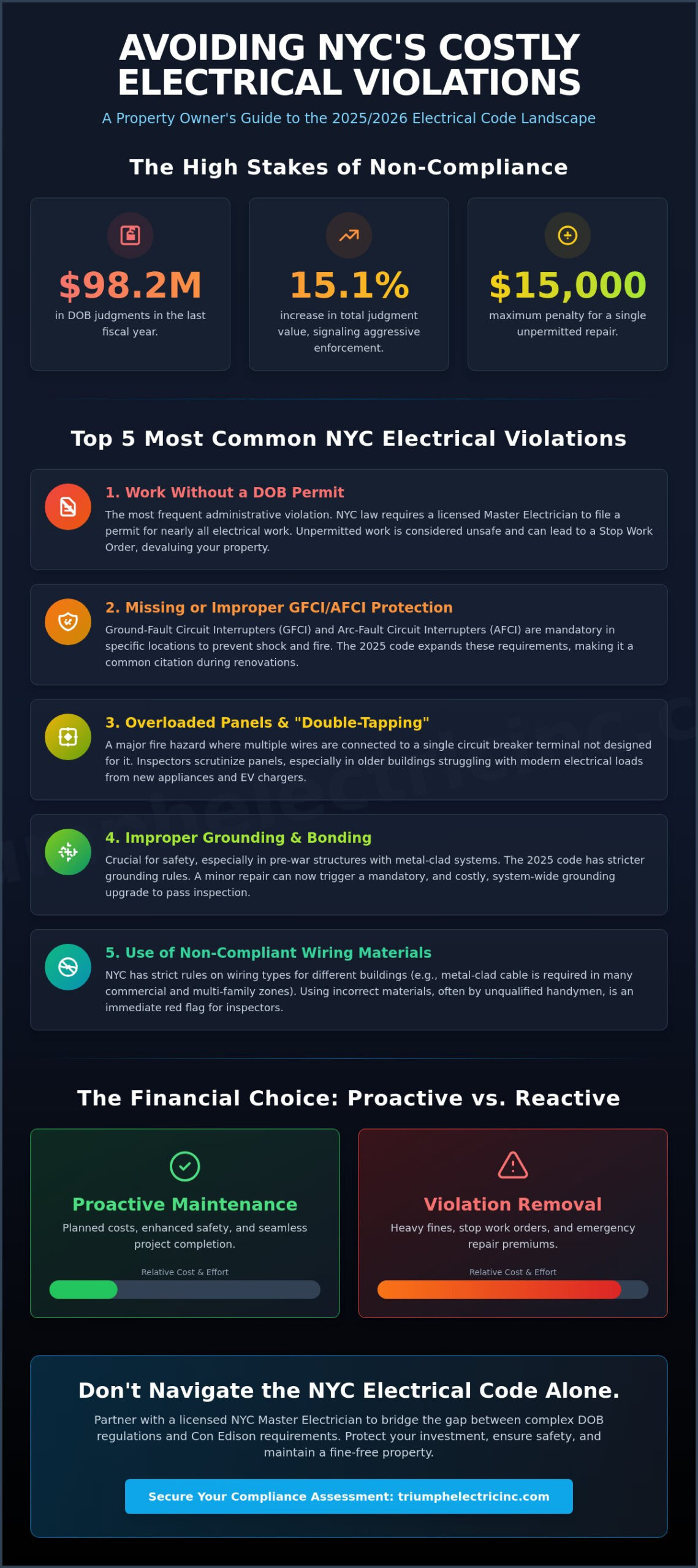
Did you know that Department of Buildings judgments reached a staggering $98.2 million in the last fiscal year? This 15.1% increase in total judgment value signals a new era of aggressive enforcement for New York property owners. You likely feel the mounting pressure of keeping an aging pre-war building up to modern standards while the regulatory landscape shifts beneath your feet. It’s deeply stressful to manage a property when a single unpermitted repair can now trigger a $15,000 penalty under the 2025 NYC Electrical Code.
Our guide simplifies the complex process of avoiding electrical code violations in new york city by providing a clear roadmap through the latest Local Law 128 requirements. You’ll learn how to protect your investment from heavy fines and ensure your building meets the strict safety standards mandated by the DOB and Con Edison. We’ll break down the new penalty structures effective as of December 2025, the 2026 electrification mandates for new construction, and the proactive steps you can take to secure a successful regulatory outcome on the first attempt. This overview gives you the technical knowledge and professional confidence to maintain a safe, compliant, and fine-free property.
Key Takeaways
- Understand the critical transition to the 2025 NYC Electrical Code and how Local Law 128 impacts your property’s legal standing in 2026.
- Identify the most common physical and administrative errors to prioritize when avoiding electrical code violations in new york city.
- Compare the long-term financial benefits of proactive maintenance against the high costs of DOB fines and emergency violation removal.
- Follow a structured 2026 roadmap to identify high-risk safety hazards like improper grounding before an inspector arrives.
- Discover how Triumph Electrical Contracting Inc. serves as your expert bridge between complex DOB regulations and Con Edison requirements.
The Stakes of Compliance: NYC Electrical Codes in 2026
The regulatory environment for New York City property owners has reached a new level of complexity in 2026. The city uses the National Electrical Code (NEC) as its technical foundation, but the New York City Department of Buildings (DOB) applies specific local amendments that are often far more stringent. These amendments account for the city’s extreme density and the unique risks associated with high-rise living. While the DOB manages the inspection and permitting process, the Environmental Control Board (ECB) handles the legal adjudication of violations. This dual-agency oversight ensures that electrical safety remains a top priority, but it also means that property owners face significant administrative hurdles when avoiding electrical code violations in new york city.
Enforcement priorities for 2026 focus heavily on fire safety in multi-family dwellings and the safe integration of EV charging infrastructure. As the city pushes toward its electrification goals, inspectors are scrutinizing high-load installations that could potentially strain aging infrastructure. Ignoring “Work Without a Permit” violations is no longer a viable option. Under the latest regulations, the financial penalties for unpermitted work in buildings other than one- or two-family homes can reach a maximum of $15,000. For smaller dwellings, the minimum penalty starts at $600, making proactive compliance the only logical financial strategy.
Understanding the 2025 Code Transition
The transition to the 2025 NYC Electrical Code, which took full effect in late December 2025, has significantly impacted residential renovations throughout 2026. Many property owners in Manhattan and Brooklyn are finding that older, “grandfathered” systems no longer pass muster during minor repairs. The updated code emphasizes stricter grounding and bonding requirements, particularly in pre-war structures where original wiring may not support modern electrical loads. If you’re planning a renovation, you must account for these new standards; otherwise, a simple circuit modification could trigger a requirement to overhaul your entire electrical panel.
The Role of Con Edison in Property Compliance
Success in the New York market requires more than just meeting DOB standards. You must also satisfy Con Edison’s specific service requirements. A common issue property owners face is the “blue card” denial. This occurs when the utility refuses to energize a system because the equipment or service entry doesn’t meet their internal specifications, even if it technically aligns with city building codes. When performing service upgrades, your plan must align with both utility and city standards to ensure a seamless power connection and avoid costly delays in project completion.
The 5 Most Common NYC Electrical Code Violations
NYC’s architectural diversity creates a unique set of challenges for property owners. From century-old pre-war masonry in Brooklyn to modern glass towers in Long Island City, every structure has specific vulnerabilities. Most citations issued by the DOB aren’t just technical glitches; they’re often the result of unpermitted work performed by unqualified handymen or DIY attempts. Success in avoiding electrical code violations in new york city requires a firm grasp of both physical safety and administrative compliance. Inspectors typically focus on these five recurring issues:
- Performing work without a required DOB permit.
- Missing or improperly installed GFCI and AFCI protection.
- Overloaded electrical panels and dangerous “double-tapping.”
- Improper grounding and bonding, especially in older metal-clad systems.
- Using non-compliant wiring materials in commercial or high-density residential zones.
Violation #1: Working Without a NYC DOB Permit
The most frequent administrative violation is performing work without a permit. NYC law requires a licensed Master Electrician to file a permit for almost all electrical work beyond simple repairs. Even “minor” renovations, such as adding new outlets or installing recessed lighting, require official filing. A “Work Without a Permit” violation often leads to a Stop Work Order. This halts all construction and significantly devalues your property during a sale or refinancing process. The New York City Electrical Code makes it clear: if the work is unrecorded, it’s considered unsafe.
Violation #2: Improper GFCI and AFCI Protection
Safety technology has evolved, and the 2026 standards are more demanding. Ground Fault Circuit Interrupters (GFCI) are mandatory in kitchens, bathrooms, and laundry areas. However, many owners fail to update these during renovations. Similarly, Arc Fault Circuit Interrupter (AFCI) requirements have expanded into nearly all residential rooms to prevent fires caused by damaged wiring. Inspectors frequently flag systems where outlets are “daisy-chained” incorrectly or where the wrong breaker type was installed. These small errors often indicate larger systemic risks that require professional troubleshooting and repair to rectify.
Violation #3: Overloaded Panels and Double-Tapping
NYC’s high power demand often outpaces the capacity of aging electrical panels. “Double-tapping,” which is connecting two wires to a single-pole breaker designed for only one, is a common but dangerous shortcut. This creates loose connections and potential fire hazards. If your building struggles with modern appliance loads, a Con Edison service upgrade is often the necessary solution to ensure your system meets current demand safely and legally.
Proactive Maintenance vs. Violation Removal: A Cost Analysis
Property owners often view electrical inspections as a burdensome expense. However, the financial reality of 2026 suggests otherwise. A scheduled compliance audit is a controlled, predictable investment. In contrast, an emergency violation removal is a reactive crisis that carries unpredictable costs. Choosing a path of prevention is the most effective method for avoiding electrical code violations in new york city. Beyond the immediate repair costs, unaddressed violations trigger hidden financial drains. These include legal fees for ECB hearings, significant insurance premium hikes, and a potential drop in property valuation. For landlords, the “peace of mind” factor is equally valuable. Ensuring your building meets the official NYC electrical code reduces your personal liability and protects the safety of your tenants.
The True Cost of a NYC DOB Fine
The Department of Buildings has intensified its penalty structure to discourage negligence. For buildings other than one- or two-family dwellings, the penalty for work without a permit is now 21 times the permit fee. This results in a minimum fine of $6,000 and a maximum of $15,000. Class 1 violations, categorized as “Immediately Hazardous,” require instant attention and carry the highest daily accruing penalties if you fail to certify correction. When these citations arrive, NYC electrical violation removal becomes a race against the clock to stop the accumulation of fines. It’s far more cost-effective to identify these issues during a routine check than to pay for the DOB’s mandatory judgments, which totaled $98.2 million citywide in fiscal year 2025.
ROI of Electrical System Modernization
Modernizing your infrastructure offers a measurable return on investment. Upgrading to code-compliant LED systems and smart controls significantly lowers energy costs. Furthermore, new circuit breaker panel installations reduce the frequency of expensive emergency troubleshooting calls. These upgrades don’t just save money; they make your property more attractive to high-value commercial and residential tenants who prioritize modern amenities and reliable power. A robust, documented electrical system is a major selling point in the competitive New York real estate market. It signals to buyers and lenders that the property is a low-risk, well-maintained asset.
Managing a building’s electrical health requires a disciplined approach to maintenance. By prioritizing regular inspections, you eliminate the anxiety of non-compliance and ensure your projects meet strict professional standards. This proactive stance is the only way to navigate the rigorous 2026 regulatory environment without facing the stress of legal or financial hazards.
Your 2026 Roadmap to NYC Electrical Compliance
Achieving total compliance in the five boroughs requires a methodical strategy. It’s not enough to simply fix what looks broken; you must satisfy the specific administrative requirements of the Department of Buildings. This roadmap provides a structured path for avoiding electrical code violations in new york city by addressing both technical safety and legal documentation. Following these steps ensures your property remains safe and your legal record stays clear of costly judgments.
- Step 1: Conduct a professional Code Audit. Hire a licensed NYC Master Electrician to evaluate your system’s health and identify hidden risks.
- Step 2: Prioritize high-risk safety issues. Address critical failures like improper grounding, open wiring, or double-tapped breakers immediately.
- Step 3: Secure all necessary DOB permits. Never allow work to begin without a filed Electrical Application (ED166) to avoid “Work Without a Permit” citations.
- Step 4: Execute repairs with code-approved materials. Use NYC-specific wire gauges and conduit types mandated for high-density residential and commercial zones.
- Step 5: File the Certificate of Electrical Inspection. This final document is the only way to officially clear the property record and prove compliance to insurers or buyers.
Conducting a Comprehensive Code Audit
A professional audit goes beyond a simple walkthrough. A Master Electrician examines panel health, wiring integrity, and device placement to ensure every component meets 2026 standards. We test for proper grounding and bonding throughout the facility, which is a frequent failure point in older Brooklyn and Manhattan buildings. Crucially, this audit includes a review of existing DOB records. Many owners are surprised to find “open” violations from previous decades that were never properly dismissed. Identifying these early allows Triumph Electrical Contracting Inc. to bundle the resolution with current service upgrades, saving time and administrative fees.
Navigating the DOB Filing Process
The administrative side of avoiding electrical code violations in new york city is often where property owners stumble. Every significant project must start with the ED166 form filed by a licensed professional. You should always verify your contractor’s credentials through the official DOB portal to ensure they’re authorized to pull permits in the city. Once the work is complete, a city official will perform a final inspection. They’ll verify that the installation matches the filed plans and meets all local amendments. Having a seasoned professional from Triumph Electrical Contracting Inc. present during this inspection is the best way to resolve technical questions on the spot and secure your certification on the first attempt.
Don’t wait for a DOB inspector to find your building’s weaknesses. If you suspect your wiring is out of date, contact Triumph Electrical Contracting Inc. today for a professional inspection and troubleshooting and repair to secure your property’s future.
Why a Licensed NYC Master Electrician is Your Best Defense
Professional licensing in New York City is among the most rigorous in the nation. A NYC Master Electrician must demonstrate seven years of supervised experience and pass exhaustive technical and legal examinations. This high bar ensures that when you hire a professional for avoiding electrical code violations in new york city, you’re working with someone who understands the life-safety implications of every wire and conduit. Triumph Electrical Contracting Inc., founded in 2012, brings over a decade of direct experience with the specific architectural challenges found across the five boroughs. We act as the essential bridge between property owners and the dense bureaucracy of the DOB and Con Edison. If a hazardous violation is discovered, our 24/7 emergency support stabilizes the situation immediately to prevent further legal or physical risk.
Our role is to protect your interests by ensuring all work follows established rules to the letter. This disciplined approach removes the anxiety of non-compliance. We handle the complex interface between technical field work and administrative filing, providing a seamless experience for property managers and owners alike. By choosing a seasoned expert, you ensure that your building’s infrastructure is managed by a dependable guardian of local standards.
The Triumph Electrical Contracting Inc. Advantage: Precision and Compliance
Our team specializes in achieving successful regulatory outcomes on the first attempt. This “Right the First Time” approach is central to our reputation as a premier licensed electrician NYC provider. Triumph Electrical Contracting Inc. manages the entire paperwork trail, ensuring every permit application is accurate and every final sign-off is recorded. Whether your property is in Manhattan, Brooklyn, or Queens, we apply the same disciplined precision to every project. We understand the nuances of both pre-war wiring and modern high-rise systems, allowing us to provide tailored solutions that meet 2026 compliance standards without unnecessary complications.
Protect Your Investment Today
Waiting for a city inspector to identify flaws in your building is a high-risk strategy. Proactive evaluation is the only way to maintain your property’s legal and financial standing. As an established electrical contracting firm, Triumph Electrical Contracting Inc. provides the technical clarity you need to stay ahead of enforcement trends. We identify potential violations before they become costly judgments, allowing for scheduled, cost-effective repairs rather than emergency interventions. Secure your property’s safety and value by partnering with a team that values precision as much as you do.
Don’t let regulatory changes jeopardize your property’s standing. Schedule your 2026 NYC Code Compliance Audit with Triumph Electrical Contracting Inc. to ensure your building meets the highest professional and legal standards.
Secure Your Property’s Future through Code Compliance
Navigating the 2026 regulatory landscape requires a disciplined focus on both technical safety and administrative accuracy. As New York City continues its shift toward full electrification, the costs of negligence have never been higher. By prioritizing professional code audits and securing proper permits, you protect your investment from the rising judgments issued by the Department of Buildings. Avoiding electrical code violations in new york city isn’t just about escaping fines. It’s about ensuring the long-term safety of your tenants and the legal integrity of your building.
Since 2012, Triumph Electrical has served all five boroughs as a dependable guardian of local infrastructure. Our team provides the expertise of a Licensed NYC Master Electrician and the reliability of 24/7 emergency service to stabilize any hazardous situation. We handle the complex paperwork trail so you can focus on managing your property with total peace of mind. Clear your NYC electrical violations today with Triumph Electrical Contracting. You’ve worked hard to build your property’s value; let’s work together to keep it safe and compliant for years to come.
Frequently Asked Questions
What is the most common electrical violation in New York City?
The most frequent violation is performing work without a Department of Buildings permit. This typically occurs when property owners hire unlicensed handymen for renovations or equipment installations instead of a Licensed Master Electrician. These unrecorded modifications remain on the building’s permanent record until a professional files the correct paperwork to dismiss the citation and ensure the installation meets 2026 safety standards.
How much are the fines for NYC electrical code violations in 2026?
As of December 21, 2025, the penalties for unpermitted electrical work are based on the permit fee. For one- or two-family dwellings, the fine is six times the permit fee, with a minimum of $600. For all other building types, the penalty is 21 times the permit fee. This results in a minimum fine of $6,000 and a maximum of $15,000 per violation.
Can I fix an electrical violation myself if it is in my own home?
You cannot legally perform your own electrical repairs or installations in New York City, even within your own residence. The NYC Administrative Code requires a Licensed Master Electrician to perform all electrical work and file the necessary permits. Attempting DIY repairs often leads to “Work Without a Permit” violations and creates significant fire safety hazards that can void your property insurance.
How do I check if my NYC property has open electrical violations?
Property owners can check for open violations by visiting the NYC Department of Buildings website and using the Building Information System (BIS) or the DOB NOW portal. By entering your street address or borough, block, and lot (BBL), you can view the full history of complaints, violations, and active permits. Identifying these issues early is a critical step in avoiding electrical code violations in new york city.
What is the difference between a DOB violation and an ECB violation?
A DOB violation is a technical notice that a property does not comply with a specific building code. An ECB violation, or OATH summons, is a legal matter that includes a financial penalty and a requirement to appear at a hearing. While a DOB violation stays on the building record, an ECB violation requires a formal certification of correction to stop escalating daily fines.
How long do I have to fix an electrical violation once I receive a notice?
The timeframe depends on the violation’s classification. Class 1 (Immediately Hazardous) violations require instant attention to protect public safety. For many Class 2 violations, the city provides a “cure” period, typically 30 to 40 days. During this window, you can certify the correction with the DOB to avoid a hearing and the associated financial penalties.
Do I need a permit to change a light fixture or outlet in NYC?
You don’t need a permit for minor repairs, such as replacing an existing light fixture or outlet with a similar model in the same location. However, you must hire a licensed professional for any work that involves adding new wiring, moving a device, or performing circuit breaker panel installations. These modifications are essential for avoiding electrical code violations in new york city.
Why did Con Edison deny my service upgrade request?
Con Edison often denies service upgrade requests if the new equipment does not meet their specific technical standards or if the building’s service entry is inadequate for the requested load. A denial can also occur if the DOB has not issued a final electrical sign-off. Ensuring your project aligns with both utility and city standards is the best way to prevent these costly delays.