If your Bronx home still relies on a 60-amp service from the mid-20th century, you aren’t just dealing with flickering lights; you’re operating on a system that predates modern standards by seven decades. You likely feel the frustration of a circuit breaker tripping every time the air conditioner kicks in. It’s a stressful situation that leaves many homeowners worried about potential fire hazards in their aging walls. Securing an electrical service upgrade old house bronx residents can trust is about more than just swapping a panel. It’s about bringing a piece of New York history into the modern era of electrification.
We understand that navigating Con Edison requirements and Department of Buildings permits feels overwhelming. This guide provides a clear roadmap for your 2026 project, from managing the $64 initial permit fee to complying with the 2025 NYC Electrical Code updates that took effect on December 21. You’ll learn exactly how to transition to a safe 200-amp service, which typically costs between $1,465 and $2,250 in the city. We’ll also preview the five-step legal process and show you how to claim up to $4,000 in NYSERDA EmPower+ rebates to protect your investment and your family.
Key Takeaways
- Choose between 100-amp and 200-amp capacities to support modern high-draw appliances and upcoming electrification requirements.
- Calculate the true cost of an electrical service upgrade old house bronx by evaluating structural factors like historic plaster walls and Con Edison service entrance requirements.
- Navigate the mandatory 5-step NYC legal process, including filing a load letter and securing DOB permits to comply with the 2025 NYC Electrical Code.
- Learn how a licensed Master Electrician manages the technical and bureaucratic hurdles to ensure your home passes inspection the first time.
Why Your Old Bronx House Needs an Electrical Service Upgrade
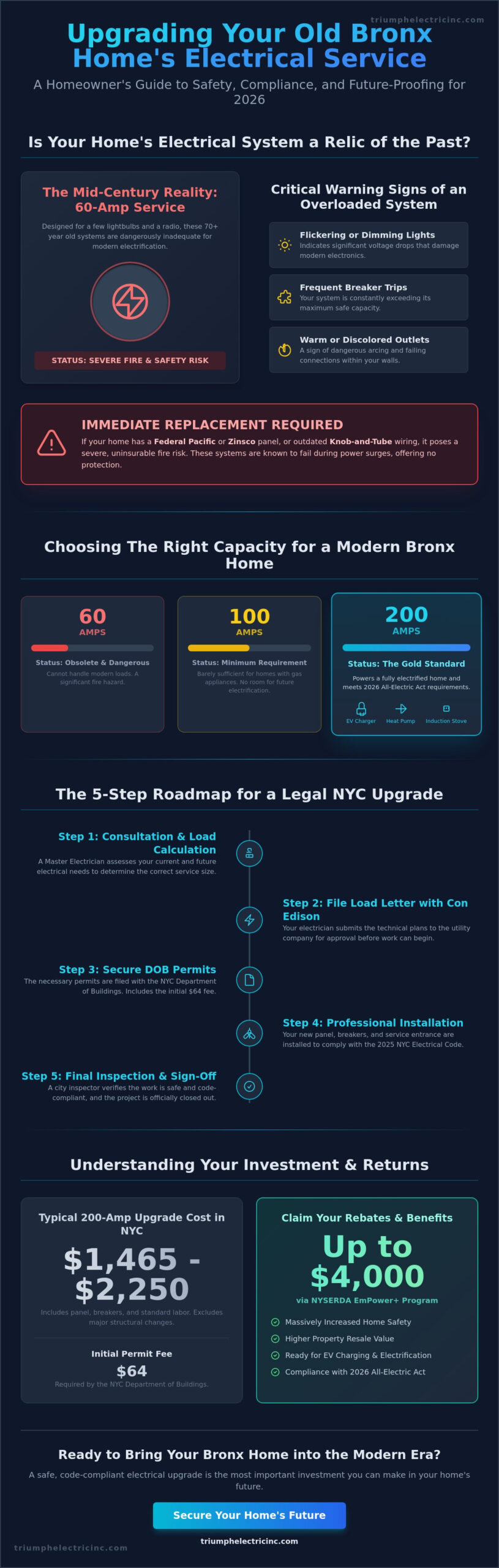
Bronx homes built in the 1940s were designed to power a few light bulbs and a radio. In 2026, those same structures must support heat pumps, electric vehicles, and high-speed data networks. An electrical service upgrade old house bronx project is no longer a luxury; it’s a safety requirement. Most historical properties in neighborhoods like Pelham Bay or Riverdale still operate on a 60-amp or 100-amp “Bronx Baseline” that simply cannot handle modern loads. With the New York State All-Electric Buildings Act taking effect on January 1, 2026, the shift toward electric heating and cooking makes a robust electrical foundation essential for property value and functionality.
Understanding electrical wiring principles is vital for identifying why these older systems fail. Original cloth-insulated wiring becomes brittle over 80 years, leading to exposed conductors and dangerous arcing. When you add high-draw appliances like modern HVAC systems or EV chargers, you push these fragile circuits beyond their engineered limits. Upgrading to a 200-amp foundation ensures your home meets the 2025 NYC Electrical Code standards while preventing catastrophic failure. This isn’t just about convenience; it’s about ensuring your infrastructure is code-compliant and capable of handling the 40% to 60% higher demand seen in modern Northeast homes.
Signs of an Overloaded System in Aging Properties
You might notice lights flickering when a window AC unit cycles on. This indicates a significant voltage drop that damages sensitive electronics. In many pre-war Bronx apartments, we still find the dangerous legacy of “pennies in the fuse box,” where previous owners bypassed safety devices to stop fuses from blowing. If your outlets feel warm to the touch or you smell a faint ozone scent in your walls, your system is failing under pressure. Watch for these common indicators:
- Flickering or dimming lights when heavy appliances start.
- Frequent breaker trips or blown fuses during summer months.
- Discolored, charred, or warm outlet covers.
- A lack of three-prong grounded outlets throughout the house.
The Safety Risks of Outdated Infrastructure
Certain brands, specifically Federal Pacific and Zinsco, are notorious for circuit breakers that refuse to trip during a surge. These panels are a “replace immediately” priority for any responsible Bronx homeowner. Historical wiring also lacks modern Ground Fault Circuit Interrupter (GFCI) and Arc Fault Circuit Interrupter (AFCI) protection required by current NYC DOB standards. These safety devices are critical in preventing shocks in kitchens and fires in bedrooms. Knob-and-tube wiring in 1920s homes represents a severe fire risk because the lack of a ground wire and the presence of combustible insulation create a perfect environment for electrical fires when the system is pushed to modern capacities.
100 Amp vs. 200 Amp: Choosing the Right Capacity for Your Bronx Home
Deciding between a 100-amp and 200-amp service is a critical step in your electrical service upgrade old house bronx project. While a 100-amp panel meets the absolute minimum requirements for small Bronx apartments or single-family homes with gas appliances, it leaves no room for growth. If you plan to install a heat pump or an induction stove to comply with the 2026 All-Electric Buildings Act, 100 amps will fail almost immediately. A 200-amp service is now the gold standard for modern Bronx residential renovations. It provides the necessary headroom for high-draw items like EV chargers and central air conditioning systems without the risk of overloading your main breaker.
The Bronx housing stock presents unique challenges that influence this decision. A three-story brownstone converted into a multi-family dwelling requires a much more sophisticated load calculation than a standalone house in Woodlawn. In these multi-family conversions, the total load must account for multiple kitchens and laundry sets running simultaneously. Choosing a higher capacity isn’t just about power; it’s about following the NYC Electrical Code to ensure your property remains legal and insurable. Future-proofing your home with a 200-amp service also adds significant resale value, as NYC buyers in 2026 specifically look for properties that are “EV-ready” and capable of supporting a fully electrified lifestyle.
Load Calculation: What Does Your Home Actually Draw?
Amperage is only half the story. You also need physical circuit space. Older 60-amp or 100-amp panels often lack the “slots” needed for new dedicated lines. When we perform a load calculation, we look at your peak simultaneous usage. If you’re running a dryer, a dishwasher, and two window AC units, a 100-amp system is likely at 90% capacity. This leaves your home vulnerable to heat buildup and nuisance tripping. For those planning a Con Edison service upgrade, we recommend 200 amps to ensure your infrastructure can handle the demands of 2026 and beyond. You can schedule a professional load assessment to see exactly how much power your current lifestyle requires.
Capacity Comparison Table
| Capacity | Best For | Key Support | NYC Code Context |
|---|---|---|---|
| 100 Amp | Small apartments | Basic lighting, gas appliances | Minimum for existing dwellings |
| 150 Amp | Medium single-family | Central air, 1-2 high-draw items | Common for mid-sized renovations |
| 200 Amp | Large homes/Multi-family | EV chargers, Heat pumps, Induction | Required for most all-electric conversions |
Selecting 200 amps provides the flexibility to add modern amenities without another expensive service call later. It’s a one-time investment that aligns with the December 21, 2025, code updates and ensures your Bronx home is prepared for the next fifty years of technological advancement.
Factors Influencing Old House Rewiring Cost in the Bronx
The architectural history of the Bronx directly dictates the budget for an electrical service upgrade old house bronx project. Many local properties feature plaster and lath walls, which require significantly more labor to navigate than modern drywall. If your home has these original pre-war finishes, expect technicians to spend more time “fishing” wires to avoid destroying your historical details. Additionally, Con Edison’s service entrance requirements vary by neighborhood. An overhead connection is generally more straightforward, while underground lines in denser areas may require trenching and coordination with city agencies, which increases the total investment.
Legal compliance adds another layer to your planning. As of May 2026, the NYC Department of Buildings (DOB) requires a $64 permit fee for a standard panel upgrade. For more extensive work, the fee is calculated based on the total construction cost. This starts with a base fee of $100 for the first $5,000 of work, plus $13 for each additional $1,000. A minimum 50% upfront payment of $130 is required for these permits. These costs ensure that a DOB inspector will review the work, confirming your home meets the safety standards set on December 21, 2025.
Material vs. Labor: Where the Money Goes
Labor represents the largest portion of your quote, typically ranging from $1,000 to over $3,000 for a standard panel. Hiring a licensed electrician NYC property owners trust ensures that you aren’t just paying for parts, but for the expertise required to file DOB permits and pass inspections the first time. As of early 2026, copper costs remain volatile, and high-quality circuit breakers add another $250 to $450 to the material list. Skilled electricians use specialized tools to fish wires through finished walls, a process that minimizes the need for expensive plaster repairs later.
Hidden Costs in Historical Upgrades
Hidden costs often surface in homes built before 1960. You might encounter asbestos in old panel backings or cloth insulation that requires specialized abatement before work begins. NYC DOB regulations also demand that any major alteration brings the system up to the standards of the current code. A simple panel swap often triggers a full grounding system update because the 2025 NYC Electrical Code requires modern bonding to the street-side water pipe and the installation of two supplemental ground rods. These infrastructure updates are mandatory to avoid violations and ensure the safety of your household.
The 5-Step Process for a Legal Electrical Service Upgrade in NYC
Completing a legal electrical service upgrade old house bronx follows a precise regulatory sequence. This isn’t a simple hardware swap that a handyman can perform on a weekend. It’s a multi-agency project that requires coordination between your contractor, the NYC Department of Buildings (DOB), and Con Edison. Following the law ensures your home insurance remains valid and your property stays free of costly building violations. The process begins with a technical load letter and ends with a formal city inspection.
The standard workflow involves five critical phases:
- Load Letter Filing: Your electrician submits a work request through the Con Edison Project Center to verify the local grid can support your increased amperage.
- DOB Permit Acquisition: A Master Electrician files for the necessary permits through the DOB eFiling system.
- Physical Installation: We install the new circuit breaker panel, the exterior meter pan, and the heavy-duty service entrance cable.
- Utility Coordination: Con Edison performs the “Cut and Reconnect” to finalize the link between their street power and your new equipment.
- Final Inspection: A DOB electrical inspector reviews the installation to issue a Certificate of Electrical Inspection.
Navigating Con Edison Requirements
Con Edison maintains a set of strict technical standards known as the “Blue Book.” These rules dictate exactly where a meter pan must be mounted and how high the service head must sit on your Bronx property. In neighborhoods like Riverdale or Woodlawn, coordinating overhead service drops requires specific scheduling to avoid power outages for your neighbors. You should plan for a 4-8 week process from the initial filing to the final utility sign-off. This timeline allows for the necessary reviews by utility engineers and municipal inspectors who verify that your system meets the December 21, 2025, code updates.
The Importance of the Master Electrician
Only a licensed Master Electrician has the legal authority to sign off on NYC DOB filings and Con Edison work requests. Hiring unlicensed labor for an electrical service upgrade old house bronx puts your entire investment at risk. Unlicensed work often results in “Stop Work” orders and significant penalties that can reach $10,000 for one-family dwellings. Our team understands the local nuances of Bronx housing stock and handles all bureaucratic hurdles so you pass inspection the first time. If you’re ready to modernize your home’s power, you can consult with our licensed Bronx specialists to start your permit filing today.
Partnering with Triumph: New York’s Brightest for Bronx Upgrades
Triumph Electrical Contracting Inc. operates with a no-nonsense, “Straight Shooter” philosophy. We understand that an electrical service upgrade old house bronx residents invest in is a high-stakes project involving both safety and legal standing. Our team brings decades of experience navigating the specific regulatory environment of the five boroughs. We provide upfront pricing and realistic timelines, ensuring you aren’t left in the dark about costs or project duration. Every project we handle is executed with the discipline of a veteran professional who knows the NYC Electrical Code inside and out.
Many homeowners discover they need a service upgrade only after receiving a notice from the city. We specialize in NYC electrical violation removal during the upgrade process. We don’t just fix the hardware; we handle the complex paperwork required to clear your property’s record with the DOB. Our goal is to remove the stress of municipal violations by handling the process professionally and legally. To ensure your peace of mind, we provide 24/7 emergency support for our clients in the Bronx, remaining available long after the final inspection is signed off.
Expertise in Bronx Residential Architecture
The Bronx features a diverse range of architectural styles, from pre-war multi-family buildings on the Grand Concourse to historical detached homes in Woodlawn and Throgs Neck. We have a proven track record of working within these unique structures. Our technicians use precise methods to minimize disruption to your living space. We prioritize “fishing” wires through existing cavities to protect your historical plaster walls and ceilings. This disciplined approach has earned us local references across the borough, from Riverdale to Pelham Bay, where property owners value both technical skill and respect for their homes.
Ready to Power Your Home Safely?
Modernizing your electrical system is a major step toward a safer, more efficient home that is ready for the 2026 electrification standards. We are committed to helping you pass DOB inspections the first time without unnecessary delays. Our team handles every technical detail, from the initial load calculation to the final utility connection. You can rely on our expertise to ensure your project is completed to the highest standards of the law. Schedule your Bronx home electrical assessment today to receive a comprehensive estimate and start your journey toward a code-compliant, modern property.
Modernize Your Bronx Infrastructure Today
Upgrading an electrical service upgrade old house bronx property requires navigating strict Con Edison “Blue Book” standards and the 2025 NYC Electrical Code. You now have the roadmap to move from an obsolete 60-amp system to a robust 200-amp foundation that supports EV charging and modern heat pumps. This transition ensures your family’s safety while securing your home’s value in New York’s rapidly electrifying real estate market. Following the legal 5-step process protects you from the heavy penalties associated with unpermitted work.
Triumph Electrical Contracting is here to handle every technical and bureaucratic detail. As a Licensed NYC Master Electrician, we specialize in NYC DOB violation removal and provide 24/7 emergency service to keep your power running without interruption. We pride ourselves on passing inspections the first time so you can enjoy a modern, code-compliant home without the stress of legal penalties or safety hazards. Don’t let outdated wiring limit your home’s potential or compromise your security.
Get a Professional Quote for Your Bronx Service Upgrade and take the first step toward a safer, brighter future for your historical home.
Common Questions About Bronx Electrical Upgrades
How long does a typical electrical service upgrade take in the Bronx?
The entire process typically takes 4 to 8 weeks to complete from the initial filing to final utility sign-off. While the physical installation of the panel and meter pan usually requires only one business day, the timeline depends on bureaucratic steps. Most of this period involves waiting for Con Edison to review your load letter and for the NYC Department of Buildings to schedule the final inspection.
Do I need to leave my home during the electrical rewiring process?
You don’t need to leave your home while we perform the upgrade. However, your power will be disconnected for approximately 4 to 8 hours on the day we install the new equipment. We coordinate this window with you in advance to minimize disruption. If your project involves extensive rewiring behind historic plaster walls, there will be minor construction noise, but the property remains habitable throughout the process.
Will Con Edison charge me for the service upgrade on their end?
Con Edison generally doesn’t charge residential customers for standard overhead service connections from the street to the house. If your upgrade requires trenching for new underground lines or significant grid reinforcement, you might face utility-side fees. We handle the “Load Letter” filing early in the process to determine if any specific utility costs apply to your Bronx address before you commit to the project.
Can I upgrade my panel without a permit if I’m just replacing an old one?
No, you cannot legally replace or upgrade an electrical panel in New York City without a DOB permit. Performing an electrical service upgrade old house bronx without proper filing results in penalties ranging from $600 to $10,000 for one-family dwellings as of December 21, 2025. A permit is the only way to ensure the work is code-compliant, which is a requirement for maintaining your home insurance coverage.
What is the difference between a panel upgrade and a service upgrade?
A panel upgrade involves replacing only the interior circuit breaker box with a modern unit. A service upgrade is a more comprehensive project that increases the total amperage flowing into your home from the grid. This process includes replacing the interior panel, the exterior meter pan, and the service entrance cables. Most Bronx homeowners choose the full service upgrade to support high-draw appliances like heat pumps or EV chargers.
How do I know if my Bronx home has a Federal Pacific electrical panel?
You can identify a Federal Pacific panel by looking for the “Stab-Lok” brand name printed on the inside of the door or on the breakers. These units often feature distinct orange-tipped switches. Because these panels have a documented history of failing to trip during a surge, they are a major fire hazard. If you find this brand in your basement, you should prioritize a replacement to meet current safety standards.
Does a service upgrade automatically fix flickering lights in my old house?
A service upgrade fixes flickering lights caused by an overloaded main system, such as when your air conditioner cycles on. It provides the necessary capacity to handle modern electrical loads. However, if the flickering is limited to a single room, the issue might be loose connections or aging branch wiring rather than the main service. We perform a full diagnostic to ensure the upgrade addresses the root cause of your power issues.
How much does a 200 amp service upgrade typically cost in NYC?
The cost to upgrade to a 200-amp electrical panel in NYC typically ranges from $1,465 to $2,250 as of May 2026. If your electrical service upgrade old house bronx requires extensive rewiring of branch circuits or relocation of the meter, total project costs can range from $5,000 to $30,000. These figures depend on the complexity of the installation and the condition of your home’s existing infrastructure.