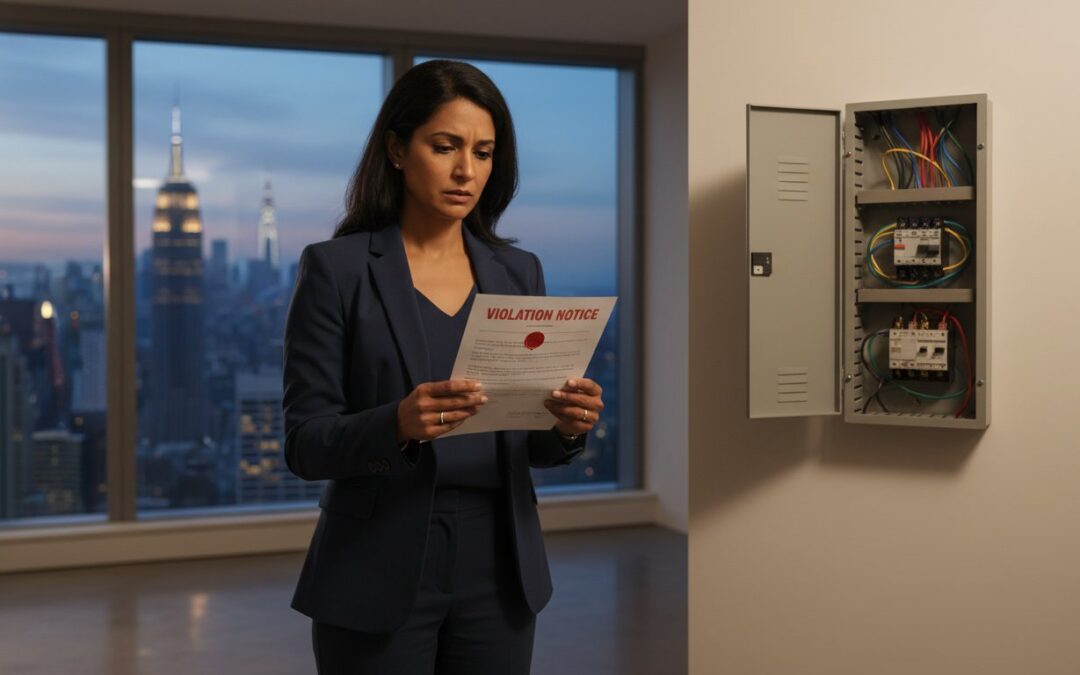
Receiving an official notice from the NYC Department of Buildings isn’t just a maintenance request; it’s a high-stakes legal event that can trigger fines as high as $15,000 under the latest 2026 penalty structures. Knowing exactly what to do if you get an electrical violation notice is the difference between a quick resolution and a permanent lien on your property. It’s understandable to feel confused by the overlap between DOB code deficiencies and ECB civil penalties. Most owners find it difficult to locate a licensed master electrician who can handle both the physical repairs and the complex city paperwork required for a successful dismissal.
We understand that your priority is protecting your investment and ensuring your building remains safe and insurance-compliant. This guide provides a definitive roadmap to help you resolve the issue quickly, legally, and safely. We’ll walk you through the process of correcting the physical code deficiency, handling the necessary DOB NOW filings, and securing the final inspection required to clear the violation from city records once and for all.
Key Takeaways
- Understand the critical distinction between a standard DOB notice and an ECB summons to avoid missing mandatory court dates.
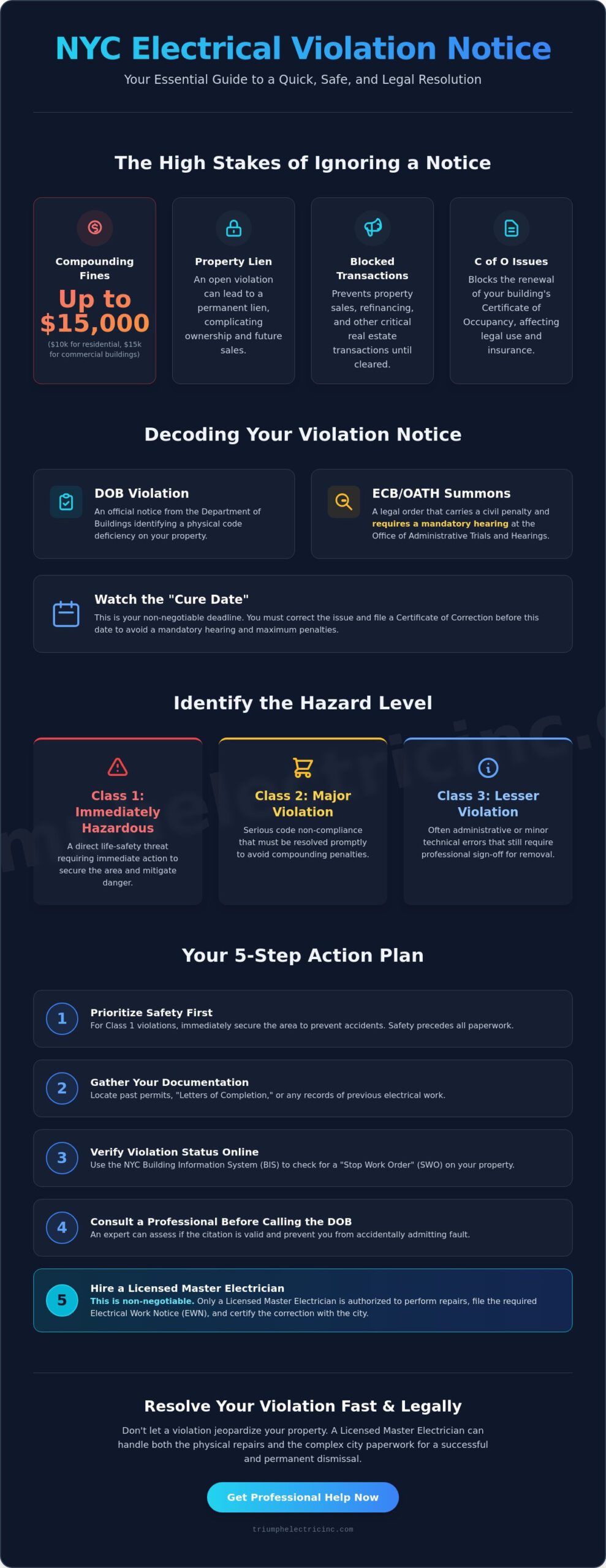
- Learn exactly what to do if you get an electrical violation notice to prevent compounding fines that can exceed $15,000 for unpermitted work.
- Discover why a Licensed Master Electrician is the only professional authorized to file an Electrical Work Notice and certify repairs with the city.
- Identify how open violations can block real estate transactions and prevent the renewal of your building’s Certificate of Occupancy.
- Gain a clear roadmap for navigating the NYC Building Information System to identify and clear all outstanding safety hazards on your property.
Decoding Your NYC Electrical Violation Notice: DOB vs. ECB
Receiving a legal notice from the New York City Department of Buildings (DOB) is a serious administrative event. It signifies that an inspector has identified a condition on your property that fails to meet the standards of the NYC Electrical Code or Title 28 of the Administrative Code. For property owners, understanding what to do if you get an electrical violation notice starts with distinguishing between a standard DOB violation and an Environmental Control Board (ECB) summons. While a DOB violation is an open notice of a code deficiency, an ECB summons is a legal order that carries a civil penalty and requires a hearing at the Office of Administrative Trials and Hearings (OATH).
Every notice contains two critical numbers: the Date of Inspection and the Cure Date. The Date of Inspection marks the moment the city officially recognized the hazard. The Cure Date is even more vital; it is the deadline by which you must correct the issue and submit a Certificate of Correction to avoid a mandatory hearing and additional fines. For violations issued after December 21, 2025, penalties are calculated under Article 213 of the NYC Buildings Code. Missing a Cure Date often results in the maximum penalty, which can reach $10,000 for residential homes and $15,000 for commercial buildings.
Identifying the Issuing Agency and Summons Type
The header of your notice identifies the specific borough office that dispatched the inspector, whether it is Manhattan, Brooklyn, or Queens. You must locate the summons or violation number immediately; this is the primary key for tracking your case in the DOB NOW: Safety portal. The notice will also categorize the hazard level:
- Class 1 (Immediately Hazardous): These require immediate action to mitigate a life-safety threat.
- Class 2 (Major): These are serious code non-compliances that do not pose an immediate danger but must be resolved to avoid compounding fines.
- Class 3 (Lesser): These often involve administrative or minor technical errors that still require professional sign-off for removal.
Common Reasons for NYC Electrical Violation Notices
Inspectors typically issue notices for specific, high-risk non-compliance issues. In residential areas like Brooklyn and Queens, illegal sub-metering or “side-of-the-house” wiring is a frequent target. In Manhattan commercial spaces, inspectors often cite exposed wiring or outdated circuit breaker panels that cannot handle modern electrical loads. The most common citation, however, is work performed without a permit. If an inspector finds new wiring, recessed lighting, or a panel upgrade that lacks a corresponding Electrical Work Notice (EWN) filed by a Licensed Master Electrician, they will issue a violation that remains on the property’s permanent record until a professional corrects the work and files the necessary certification.
5 Immediate Steps to Take After Receiving a Notice
Receiving an official notice is stressful, but the first 10 days are the most critical window for action. During this time, you can often mitigate the risk of maximum penalties by organizing your defense and identifying the exact scope of the problem. If the notice indicates a Class 1 “Immediately Hazardous” condition, your first priority is safety. Secure the area immediately and prevent access to the faulty equipment to avoid accidents that could lead to liability well beyond city fines. Professional intervention is required to stabilize the site and ensure the hazard is neutralized before any administrative work begins.
Once the site is safe, gather your documentation. Look for previous Electrical Work Notices or “Letters of Completion” from past renovations. These records prove that the work was once inspected and approved, which is essential if you believe the violation was issued in error. Before you call the DOB to argue your case, consult a Licensed Master Electrician. They understand the specific language used by inspectors and can provide an honest assessment of whether the citation is valid. If you need immediate assistance with electrical violation removal, professional guidance ensures you don’t accidentally admit to a code breach that wasn’t actually present.
Verify the Violation Status Online
Use the NYC Building Information System (BIS) to search your property profile. This tool reveals if the electrical issue has triggered a “Stop Work Order” (SWO), which halts all construction on the site. An active SWO is a major complication that requires specific clearances before any other work can proceed. Check the “Violation Status” column on your property profile; if it says “Active,” the city still considers the condition a threat. Identifying what to do if you get an electrical violation notice involves monitoring this portal until the status changes to “Resolved” or “Dismissed.”
Avoid the ‘Handyman’ Trap
It’s tempting to hire a general handyman to “fix” a cited wire or panel, but this is a dangerous legal mistake. The DOB requires a Licensed Master Electrician (LME) to certify that the correction meets current 2026 NYC Electrical Code standards. If an unlicensed worker performs the repairs, you risk receiving a second, more expensive violation for “Work Without a Permit.” The city tracks the specific license number of the professional who signs the Certificate of Correction. Without that valid license, the violation remains open, and the fines continue to accumulate daily.
The Professional Process for NYC Electrical Violation Removal
Clearing a city record requires more than a simple repair; it demands a structured administrative response. The NYC Department of Buildings requires a Licensed Master Electrician (LME) to oversee the entire corrective sequence. These professionals are the only individuals authorized to file an Electrical Work Notice (EWN), which serves as the official permit for the job. Attempting to resolve the issue without this formal filing leaves the violation open, even if the physical hazard is gone. Understanding what to do if you get an electrical violation notice means recognizing that the city prioritizes the paper trail as much as the copper wiring.
The process begins with a thorough site assessment. Your electrician must identify every specific code breach cited in the notice and determine if any additional “hidden” violations exist. Once the scope is clear, the LME files the EWN through the DOB NOW portal. This step is non-negotiable. For work performed without a permit after December 21, 2025, the city imposes penalties up to 21 times the permit fee for commercial buildings. Filing the correct paperwork immediately stops the clock on certain daily penalties and signals to the city that you are taking corrective action. After the permit is approved, the physical repair work must be executed to meet the strict standards of the 2026 NYC Electrical Code.
Hiring a Licensed Master Electrician (LME)
Always verify an electrician’s credentials through the DOB license search tool before signing a contract. A valid NYC LME license number is the only thing the city accepts on a Certificate of Correction. Triumph Electrical specializes in this high-stakes environment. We understand the specific nuances of Manhattan, Brooklyn, and Queens borough offices. Our team takes full legal responsibility for the corrective work, ensuring that every circuit breaker panel installation or fire alarm wiring job is performed to the letter of the law. This professional oversight is your best defense against rejected filings and recurring fines.
Filing the Certificate of Correction
The final step in what to do if you get an electrical violation notice is submitting the AEU2 or AEU3321 forms. These documents, known as the Certificate of Correction, must be accompanied by notarized statements, photographs of the completed fix, and copies of the paid permit receipts. If your violation was eligible for a “Cure,” submitting these forms before the specified Cure Date allows you to admit the violation and avoid a costly OATH hearing. This process effectively closes the case. It removes the lien-like status from your property title and ensures your building remains in good standing with the city and your insurance provider.
The Risks of Ignoring Electrical Violations in NYC
Delaying action on a city summons is a high-stakes gamble that rarely pays off for property owners. While the initial fine is significant, the true danger lies in the administrative “Failure to Certify” cycle. Once the Cure Date passes without a valid Certificate of Correction, the Department of Buildings begins a process of escalating enforcement. This is why knowing what to do if you get an electrical violation notice is essential for protecting your equity. Inaction transforms a simple repair into a permanent legal encumbrance that can freeze your ability to manage your property.
Beyond the financial penalties, open violations present a direct threat to your building’s Certificate of Occupancy (C of O). The DOB will not renew or modify a C of O for a building with active Class 1 or Class 2 electrical hazards. This can lead to the forced closure of commercial spaces or the inability to legally rent residential units. Additionally, insurance companies frequently review public DOB records during claim investigations. If a fire occurs and an inspector finds that an open electrical violation was ignored, the carrier may have legal grounds to deny the claim entirely, leaving you personally liable for all damages.
Compounding Fines and Legal Liens
The city operates on a 45-day enforcement cycle for uncorrected violations. If you fail to certify the fix, the DOB can issue additional “Failure to Certify” penalties that often exceed the cost of the original repair. These debts do not simply disappear; they eventually turn into civil judgments. In boroughs like Brooklyn and Queens, the city frequently places legal liens on properties with unpaid ECB judgments. These liens appear on your property title and must be satisfied before any bank will approve a refinancing application. If you are struggling with a complex case, contact us for professional electrical violation removal to stop the accumulation of daily fines.
Impact on Property Value and Sales
Open violations are a major red flag during any real estate transaction. Every title search conducted by a buyer’s attorney will highlight active DOB and ECB issues. In the current NYC market, savvy buyers often demand an “escrow holdback” for open violations. This means a portion of your sale proceeds is frozen in an account, often at double or triple the estimated repair cost, until the city officially dismisses the case. Hiring a licensed electrician NYC property owners trust is an investment in your building’s marketability. Clearing these records ensures a smooth closing and prevents buyers from using your code deficiencies as leverage to negotiate a lower sale price.
How Triumph Electrical Expedites Your Violation Removal
Triumph Electrical understands that city-issued notices are time-sensitive legal matters. When property owners consider what to do if you get an electrical violation notice, their first priority is securing a partner who understands the specific administrative workflows of the borough offices. We provide 24/7 emergency response for Class 1 “Immediately Hazardous” conditions to protect your tenants and your property from immediate danger. Our team handles every aspect of the resolution process. This includes the initial physical repair, the filing of the Electrical Work Notice, and the final submission of the Certificate of Correction. Our “First-Time Resolution” guarantee provides the peace of mind that your case will be closed without the need for multiple follow-up visits.
Our direct experience with Manhattan, Brooklyn, and Queens DOB borough offices allows us to navigate local nuances that often stall other contractors. Each district has specific reporting preferences and inspector expectations. We manage these relationships so you don’t have to. By providing a turnkey service, we eliminate the need for property owners to coordinate between multiple vendors or legal consultants. We deliver a single, professional point of contact for the entire lifecycle of the violation. We know the 2026 NYC Electrical Code requirements inside and out, ensuring your building meets all current safety standards.
Our Comprehensive Compliance Audit
We perform a comprehensive compliance audit before any city inspector returns to the site for a re-inspection. This proactive approach identifies hidden code issues in your circuit breaker panels, wiring, or grounding systems that might have been missed during the initial visit. Inspectors often look for specific “red flag” conditions; we ensure those are neutralized along with the cited deficiencies. By addressing these items early, we ensure a successful regulatory outcome on the first attempt. This level of precision is why we are the preferred electrical contracting firm for NYC landlords who cannot afford the delays of recurring inspections or rejected filings.
Fast-Track Filing and Resolution
We leverage the DOB NOW: Inspections portal to expedite sign-offs and clear your property record as quickly as possible. Digital filing has streamlined the process, but only for those who know how to format the technical data correctly. If a “Cure” isn’t possible due to the timing of the notice, we prepare the technical documentation you need for ECB/OATH hearings. This documentation proves that the hazardous condition was corrected according to 2026 standards. Our goal is to remove the administrative burden from your shoulders entirely. Contact Triumph today for professional NYC electrical violation removal and restore your building’s legal standing.
Secure Your Property’s Future and Safety
Resolving a city-issued notice is a technical and administrative process that requires immediate attention. You must distinguish between DOB and ECB summonses while respecting the critical 10-day window for action. Ignoring these hazards leads to compounding fines, legal liens, and potential insurance denials. Only a professional with expert knowledge of 2026 NYC Electrical Codes can provide the necessary certification to clear your record permanently. This ensures your building remains safe and your property title stays clean for future transactions.
When you are determining what to do if you get an electrical violation notice, your first step should be consulting a specialist who understands the high stakes involved. Triumph Electrical serves as your dependable guardian of local infrastructure. As a Licensed NYC Master Electrician, we offer 24/7 Emergency Violation Repair to neutralize hazards and handle all complex city filings on your behalf. Get Your NYC Electrical Violation Removed Safely—Contact Triumph Electrical Now. We are ready to help you achieve full regulatory compliance and restore your peace of mind today.
Frequently Asked Questions
Can I fix an electrical violation myself if I own the house?
No, you cannot fix an electrical violation yourself. New York City law requires all electrical work to be performed by a Licensed Master Electrician. Property owners are not authorized to file work notices or sign off on certificates of correction. Hiring an unlicensed handyman or attempting a DIY fix will likely result in a secondary “Work Without a Permit” violation and significantly higher city fines.
How long do I have to fix an electrical violation in NYC?
You generally have a 40 day window from the date of issuance to correct the condition and file your paperwork. This timeframe is known as the “Cure” period. Meeting this deadline allows you to admit the violation and avoid a mandatory OATH hearing. If you miss this window, you lose the opportunity for a reduced penalty and must attend a hearing to contest or explain the situation.
What happens if I miss my ECB/OATH hearing date?
Missing a hearing date triggers a default judgment against the property owner. When this happens, the city automatically imposes the maximum possible penalty for that specific violation class. Unpaid default judgments eventually turn into civil liens on the property title. These liens must be satisfied before you can sell, refinance, or obtain new building permits for any future renovation work.
How much are the fines for an electrical violation in New York City?
Penalties for unpermitted work issued after December 21, 2025, are substantial. For one or two family dwellings, the minimum penalty is $600 and the maximum is $10,000. For all other building types, the minimum penalty is $6,000 and the maximum is $15,000. These figures are calculated based on the permit fee and the specific nature of the building as defined under Article 213 of the NYC Buildings Code.
Does a violation stay on my property record forever?
The record of a violation remains on the NYC Building Information System permanently. While the history is always visible, the status must be updated from “Active” to “Resolved” to satisfy legal requirements. Clearing the record involves more than just paying the fine. You must submit a Certificate of Correction that is officially accepted by the Department of Buildings to change the violation status from open to closed.
What is a ‘Certificate of Correction’ and how do I file it?
A Certificate of Correction is the formal document used to notify the DOB that a violation has been fixed. You must file this via the DOB NOW: Safety portal using forms AEU2 or AEU3321. The submission must include a notarized statement from a Licensed Master Electrician along with supporting evidence like photographs and work receipts. The city will only dismiss the violation once they verify and accept this documentation.
Can an open electrical violation stop me from selling my apartment?
An open violation is a major obstacle during a property sale. Title companies and lenders identify active DOB and ECB issues during their standard searches. Most banks will refuse to fund a loan until all hazardous electrical conditions are resolved and the record is cleared. Sellers are often forced to delay the closing or agree to expensive escrow holdbacks to cover potential city penalties and repair costs.
Do I need a permit to fix a minor electrical violation?
Almost all corrective work for an electrical violation requires a formal permit. Understanding what to do if you get an electrical violation notice means knowing that an Electrical Work Notice must be filed before repairs begin. Minor issues like exposed wiring or outdated panels still require professional oversight to ensure they meet 2026 NYC Electrical Code standards. Failure to pull the correct permit can lead to a “Work Without a Permit” citation and additional fines.